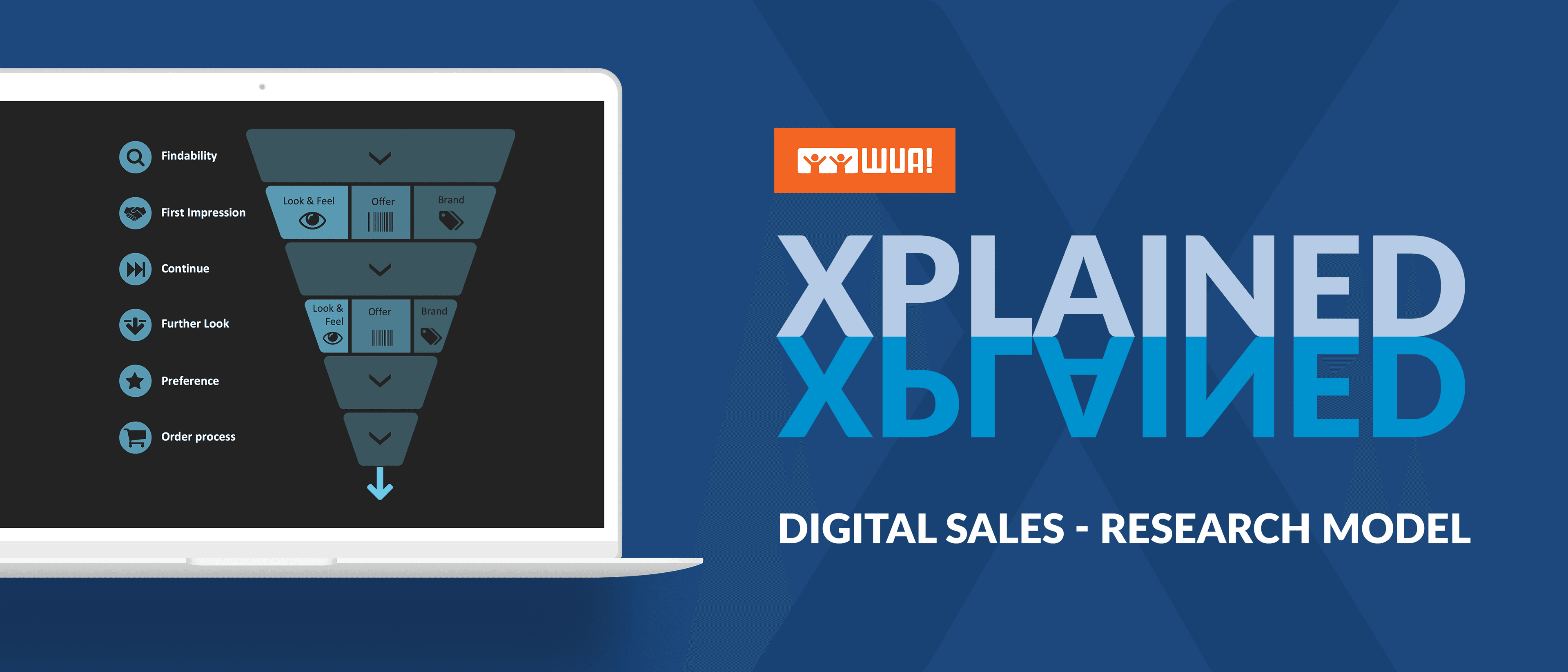
WUA has been extensively researching digital sales customer journeys for more than 15 years. These journeys can highly vary in their nature: they differ in the goal of the consumer, the product the consumer is looking for and the market in which a customer journey takes place.
WUA has conducted studies in the Insurance market (e.g.: home or car insurance), Telecom (sim only, mobile phone and plan), Finance (credit card, personal loan, investment banking) to name just a few industries and journeys. However, one element of these journeys tends to be universal: the main phases involved. WUA has captured these phases in the Digital Sales Model, which forms the basis of every customer experience study WUA carries out for digital sales journeys. This article will show you the ‘building blocks’ of the Digital Sales Model, and why researching every phase involved is crucial to gain insight in a customer journey.
From Findability to Preference (and beyond)
In a nutshell, the Digital Sales Model consists of 6 consecutive phases that take place during the customer journey (see an image of the model below):
1 – Findability
Are consumers able to find your website while searching for a product? If so, through which route?
2 – First Impression
How do consumers evaluate the first 0-60 seconds on your website?
3 – Continue
Are consumers willing to further explore your website, based on their first impression?
4 – Further Look
How do consumers assess your website on a deeper level, while fully exploring the presented content, pricing, and offer?
5 – Preference
After comparing multiple websites, do consumers ultimately choose your website to buy/apply for the desired product?
6 – Order/Application Process
After choosing your website, how do consumers evaluate the process of ordering/applying for the desired product?
The Digital Sales Model and its corresponding 6 phases are incorporated in the standardized questionnaire that we use in our customer experience studies. Output from this questionnaire reveals how consumers go through these phases on any given website and/or app.
Let’s take a closer look at each of these phases.
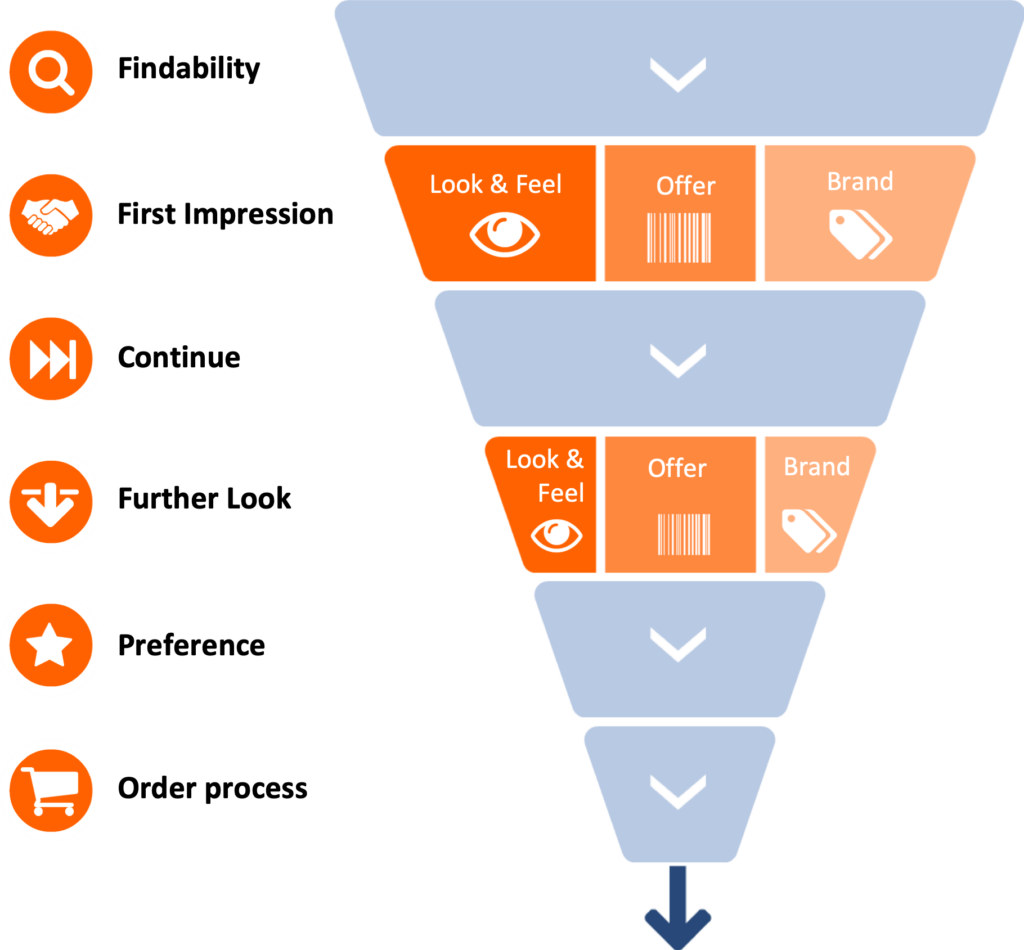
The WUA Digital Sales Model consists of three themes in both the First Impression and the Further Look phase of the customer journey. Per phase, all three themes consist of a set of open-ended and closed questions on information, products offered, contact options and brand image.
Phase 1: Findability
Many customer journeys start with consumers freely searching for websites that might suit their needs. We define Findability as the percentage of respondents who have landed on your website during their orientation on a particular product. They could potentially visit your website via a search engine or by entering the URL directly – the latter happening more often at companies with a large brand-awareness. For the ‘search engine group’, it is of vital importance to have a good SEA (paid links at the top of search results) and SEO (natural placement of links) in place. This way, you can effectively guide orienting consumers towards your website. No Findability, no customer journey.
Phase 2: First Impression
Once consumers have landed on your website, they immediately start forming an impression. What do they see? Is it relevant? What kind of company is behind this website? The First Impression phase is a crucial step in the journey, because it sets the stage for the whole customer experience. To capture this impression, we ask respondents both open-ended and closed questions. We do this to acquire qualitative comments and quantitative scores, respectively. These questions can be fit within 3 separate themes:
Look & Feel
The technical operation of the website and the way the products and services are shown. Does the way the website works make sense? Can consumers find the most relevant information at a single glance? Does the website look attractive to the visitor?
Offer
Includes everything that has to do with a provider’s product or service. This is not just the number of products and prices, but also about how easy it is for the visitor to find the options relevant to them. Immediately after arriving on the website, the thoughts that the visitor forms – the idea that the products they’re looking for can be found here – needs to be confirmed.
Brand
An online consumer wants to feel the company behind the website is trustworthy. In order to be taken seriously, a brand needs to make sure there are no contradictions in the way it presents itself. Successful brands have a consistent, credible, relevant, clear promise, and take good care of its customers. A part of this is being open to contact and dialogue.
Phase 3: Continue
Based on the immediate impression they formed, consumers express whether they think it’s worth their time and effort to continue exploring your website to find the product that they need. If so, your website is one step closer to converting the visitor. If not, you will lose interest of the visitor and thus the chance to motivate him or her to choose your product.
Phase 4: Further Look
Once consumers have decided that your website is worth a more thorough exploration, they will interact with the corresponding content and elements more extensively. In the Further Look phase, the three themes of the First Impression (Look & Feel, Offer and Brand) reappear but are now researched in much more detail.
Phase 5: Preference
Having gone through the previous customer journey phases on different websites, consumers assess which website stands out positively. They do so by evaluating and comparing these websites, considering aspects that formed a part of their overall experience: information, navigation, design, products, brand proposition, etc. Ultimately, consumers choose one website to buy their product on.Moreover, the respondents express their #2, #3, and #4 choice, and state what these websites should improve to become number 1 in their personal ranking. We define Preference of a website as an absolute percentage of respondents that see that website as their number 1 choice for buying the product.
Phase 6: Order Process
Once consumers actively decide to buy the product on your website, they initiate the order process. It is important to make this final step of the online journey as easy and intuitive as possible for consumers, so that their previous positive experiences with your website remain intact. At WUA, we see the Order Process as a ‘hygiene factor’ that must be convenient and smooth at all times. The Order Process is disconnected from the previous steps of the funnel, because it is evaluated after the Preference phase. Therefore, the Order Process phase has no influence on the overall preference statements of consumers.
How was the questionnaire for the model created and refined?
Creation & refinement
All six phases of the Digital Sales Model are linked to a variety of closed and open-ended questions. These items form the basis of our standardized research questionnaire, with which participants evaluate the customer experience on a given website or app. We created and carefully refined the questionnaire items in three consecutive steps, based on our research expertise:
Starting with a meta-data analysis, we looked at over 100.000 website evaluations with our previous questionnaire to learn which questions help us in measuring online experience best, prioritize CX-issues and predict consumer preference. Moreover, this analysis taught us more about how respondents fill out the questionnaire, where they drop out, and how we could enhance the questionnaire experience for respondents to ensure the completeness of our questionnaire, we categorized thousands of open-ended answers. What do consumers say about what they find important during a website visit? This led to a few additional elements that we integrated into our model.
Next, we re-analyzed all the questions content wise. Is the wording of our questions clear? Are we really asking what we would like to know? During many brainstorm sessions with our digital experts, we reworded the universal online customer journey and transformed it into an improved questionnaire.
How was the model tested for quality and reliability?
Putting the Digital Sales Model to the test
After the creation and refinement of our Digital Sales Model, we ran several tests. This way, we objectively made sure that our model reflected the real-world consumer experience, and that it was statistically sound and powerful. In total, we executed three tests:
In a qualitative test, we invited participants to our office to complete the questionnaire and provide us with extensive feedback. Among many insights, this pilot provided us with an even better understanding of how consumers form their first impression on a website. This insight enables us to further optimize our model.
Moreover, we conducted two quantitative tests to thoroughly check our questionnaire on a statistical level. In these pilots, we used a variety of statistical methods to answer three main research questions:
-
Are the themes and the questions they consist of interrelated in a way that fits with our theoretical model? (research method: factor analysis
-
Does every question add value to the model? (research method: correlation and reliability analysis)
-
Do the questions enable us to predict which website is ultimately preferred by the consumer? (research method: regression analysis)
Based on the statistical output we gained from analyzing over 3.000 website evaluations, we selected the very best questions to measure the online customer journey accurately while keeping the questionnaire as concise as possible.
How does the model help prioritize CX issues?
Prioritizing CX-issues with predictive modelling
What has the extensive refinement and testing of our Digital Sales Model yielded? Well, one of the most important benefits of the model is its high predictive power. Overall, the elements in our model predict in 80 percent of all cases which website consumers give the highest overall opinion! Overall opinion is strongly connected with preference. This means that we measure (nearly) all relevant aspects of the customer journey in our model.
More specifically, we can perform predictive modelling via regression analyses. This means that we can use the scores on the 3 main themes of the model (i.e., Look & Feel, Offer, and Brand) to make accurate predictions about consumer behavior on any given website.
Looking at the building blocks of the model, we can calculate (using regression analyses) the relative importance of each theme in the First Impression, when it comes to consumers deciding whether to continue on the website they visit. When combined with the CX-scores that are related to these themes relative to those of competitors, we can pinpoint the most impactful CX-issues that stop visitors from further exploring the website.
Moreover, we can calculate similar CX-priorities in the Further Look phase: by conducting regression analyses on the themes Offer and Brand in this phase (since Look & Feel has a more indirect impact here), we know which themes are most important in creating consumer preference for a website within a market. Pairing this data with the CX-scores of underlying components of the themes (e.g., perceived expertise, price perception) and comparing them to scores of competitors, CX-priorities come to light.
Let's look at an example (see Image 2 below): company A might perform well online on most brand-related elements compared to competitors, but might lack a clear product offer. In this example, product offer is highly important for generating preference for that website within the market. As a result, consumers prefer competitor B that does slightly better in presenting their products. If website A wants to increase the preference they get from consumers and thus, increase conversion and market share, the model shows that they need to improve offer-related components on their website to beat competitor B.
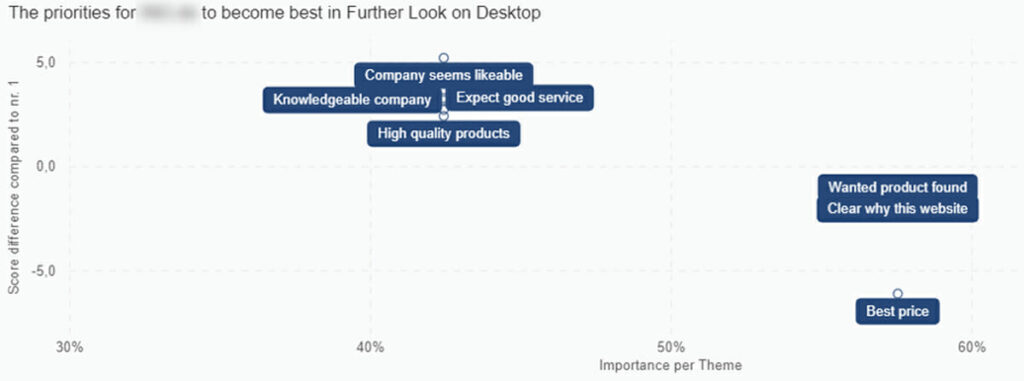
Image 2: The Priority Matrix for company A in the Further Look phase on desktop. The x-axis represents the relative importance of the themes Product Offer and Brand (the graph shows the questions these themes consist of) in generating overall opinion. The y-axis represents score difference on these questions, relative to the best scoring competitor in the market.
The Digital Sales Model & Benchmarking
In conclusion, the Digital Sales Model captures all the phases a consumer goes through when looking for a product online. By integrating these phases in our standardized customer experience questionnaire, we can effectively compare evaluations of sales journeys within and between various markets and industries, on a national but also on an international level.