I'm surely not the only one who hardly ever googles the traditional way anymore, clicking through a few websites one by one. My questions go to Claude or ChatGPT. And when I do open Google, I read the AI answer at the top first. What AI tells me there largely decides who I end up buying from.
Most companies think they know their customers. Whether that's true only becomes clear when you measure what customers actually experience. Making that visible has been our work for almost twenty years. Now customer experience is getting a new dimension: the picture AI has of you and how it describes you to the customer.
That's why we built a benchmark at WUA that measures AI visibility: how often and how positively AI assistants name companies. We started with Dutch health insurers. They're in the middle of the switching season, so right now it's especially interesting for them to see where they stand.
The figures in this piece come from that market, but take it from me: the lessons apply to every company whose customers ask AI for advice.
Key insights
-
AI visibility shows whether AI assistants name your brand when someone makes a choice, and what they say about you.
-
AI's opinion weighs as heavily as your customers'. An AI assistant advises your customer before they even visit your website.
-
A mention means little without a positive opinion. In WUA's AI visibility benchmark for Dutch health insurers (400 answers from five AI assistants, start measurement October 2026), AI is positive about the second most-mentioned insurer in only 1 in 5 answers, and about another in almost 70%.
-
A clear profile seems to pay off more than size. In the same benchmark, AI names a smaller insurer most often, in about 35% of answers. Of the four largest insurers, only one makes the top 3.
-
Your reputation in AI is largely built outside your own website. More than half of the links in AI answers go to comparison sites, testing organisations and media. The leader in AI doesn't make Google's top 10 for any of the search terms we track.
-
Reliable conclusions take a lot of measurements. Answers differ per assistant and per situation. That's why WUA measures hundreds of answers from five AI assistants in four situations and updates the figures every day.
What does an AI assistant do differently from a search engine?
With a search engine, you look for a company and get a list. Right now, that list is mostly ads.
AI takes on much more of an advisory role and gives its opinion. Ask which health insurer has the most satisfied customers and you get a few names, with what AI thinks of each one.
It gets that opinion from somewhere. As a company, you want to steer that, because it plays an important role in the choices your audience makes.
Does your website still count when people ask AI for advice?
You sometimes hear that the website is going to disappear. Twenty years ago we said the same about shops. They're still here.
Websites will keep playing a role, but that role is changing. AI assistants read your website as an important source on what you offer.
So you need to make sure you come across well there. That takes more than what you used to do with SEO.
Why start with health insurers?
Because we're in the middle of the season when people switch health insurers. My estimate is that this switching season is the first year AI really counts in the choice of a health insurer. Last switching season, 23% of people exploring health insurance already used AI to do so, according to research by Riverwise. This year that will only grow.
A health insurance policy is also a complex product. AI helps with that. Say you have a condition and want to know how insurers deal with it: you let an assistant find out whether one insurer handles it differently from another. It's exactly with those harder, personal questions that people turn to AI.
So you need to know three things about your reputation in the eyes of AI assistants:
-
what that reputation is
-
how it's influenced
-
what makes you do well
That goes for health insurers, but just as much for any other company.
What's a mention by AI worth?
If AI names you but isn't very positive about you, that mention is worth little. You need to excel at something in the eyes of an AI assistant. Otherwise you'll come across there as just another one of the same.
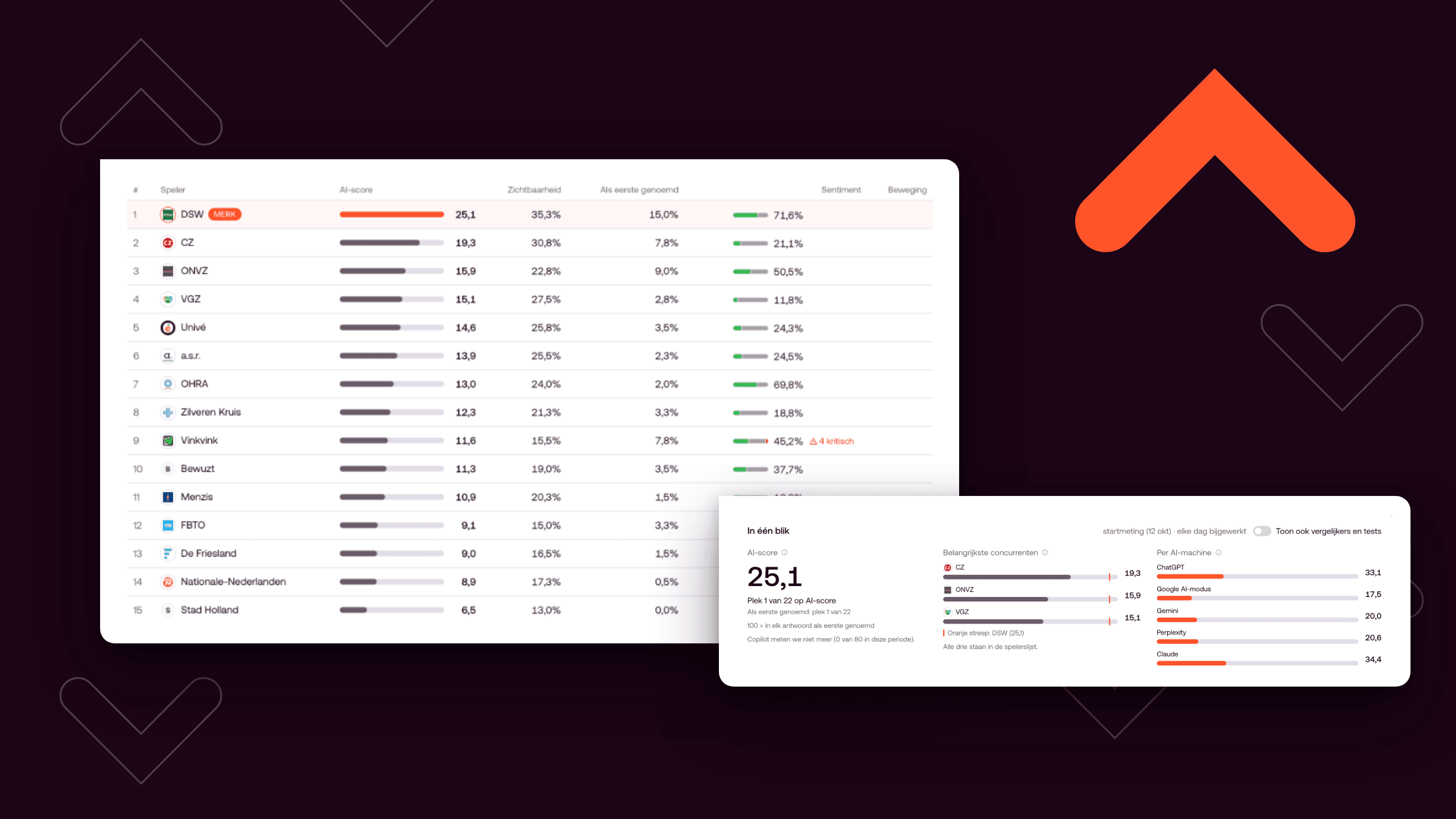
You can see that in our first measurement. AI is far more positive about one insurer than another: it praises OHRA in 69.8% of the answers that mention OHRA, CZ in 21.1%. And being big alone doesn't put you at the top. DSW, a smaller insurer, is the one AI names most often, in 35.3% of answers. Of the four largest insurers, only CZ makes the top 3. The full ranking shows who leads on which theme.
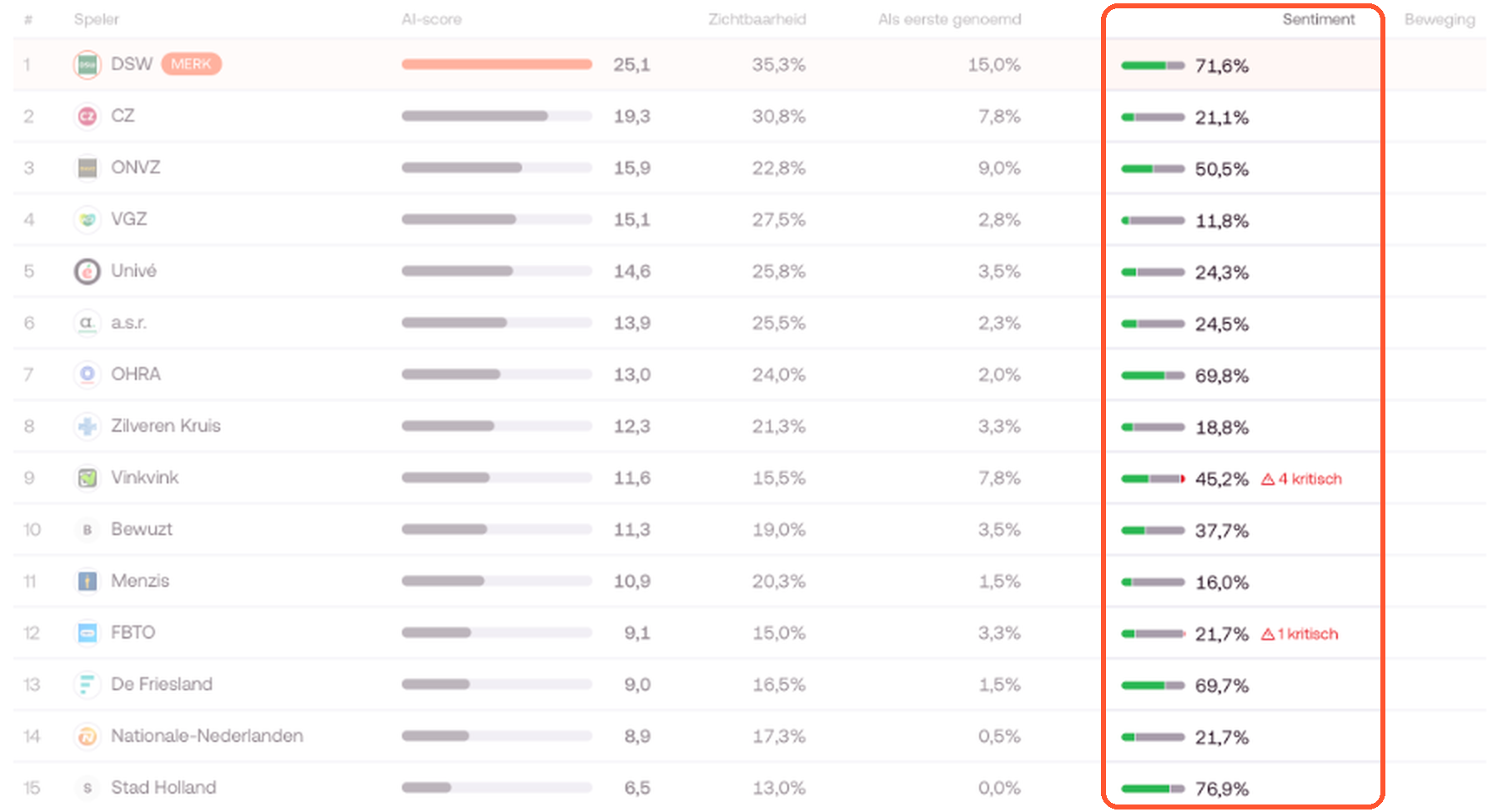
How often AI is positive about an insurer when it mentions it (Sentiment column): OHRA 69.8%, CZ 21.1%. WUA's AI visibility benchmark, start measurement October 2026.
Companies that choose a niche seem to get mentioned sooner. For the big four, the hard part is standing out in the eyes of AI.
Where does AI get its opinion of a company?
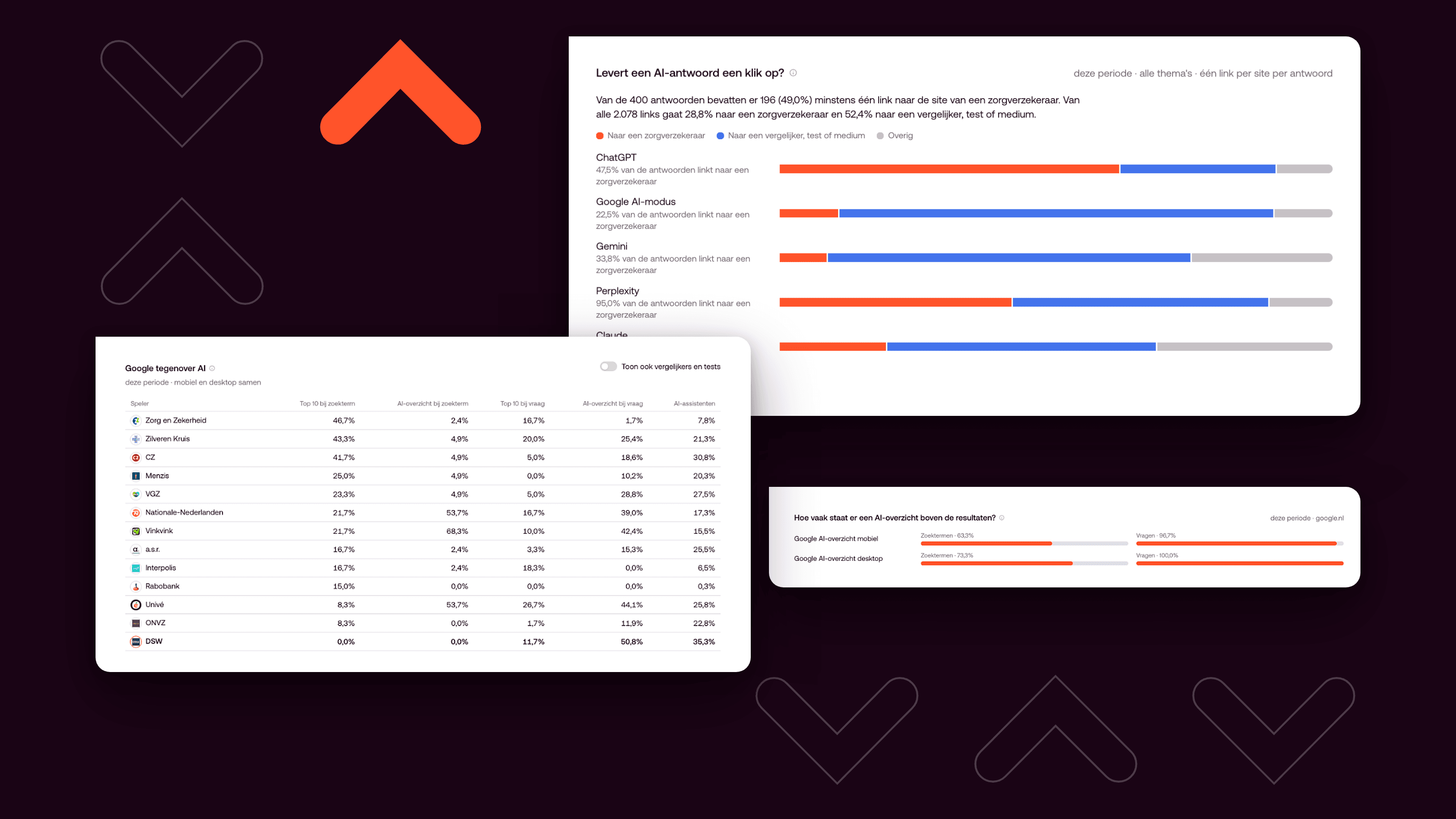
AI gets its opinion partly from your own website, but mostly from what others write about you. Of the 2,078 links in the answers we collected, 52.4% go to comparison sites, testing organisations and media. 28.8% go to the insurers themselves. People do the same: in WUA's own market research, 48% of Dutch people who took out health insurance had looked at a comparison site first.
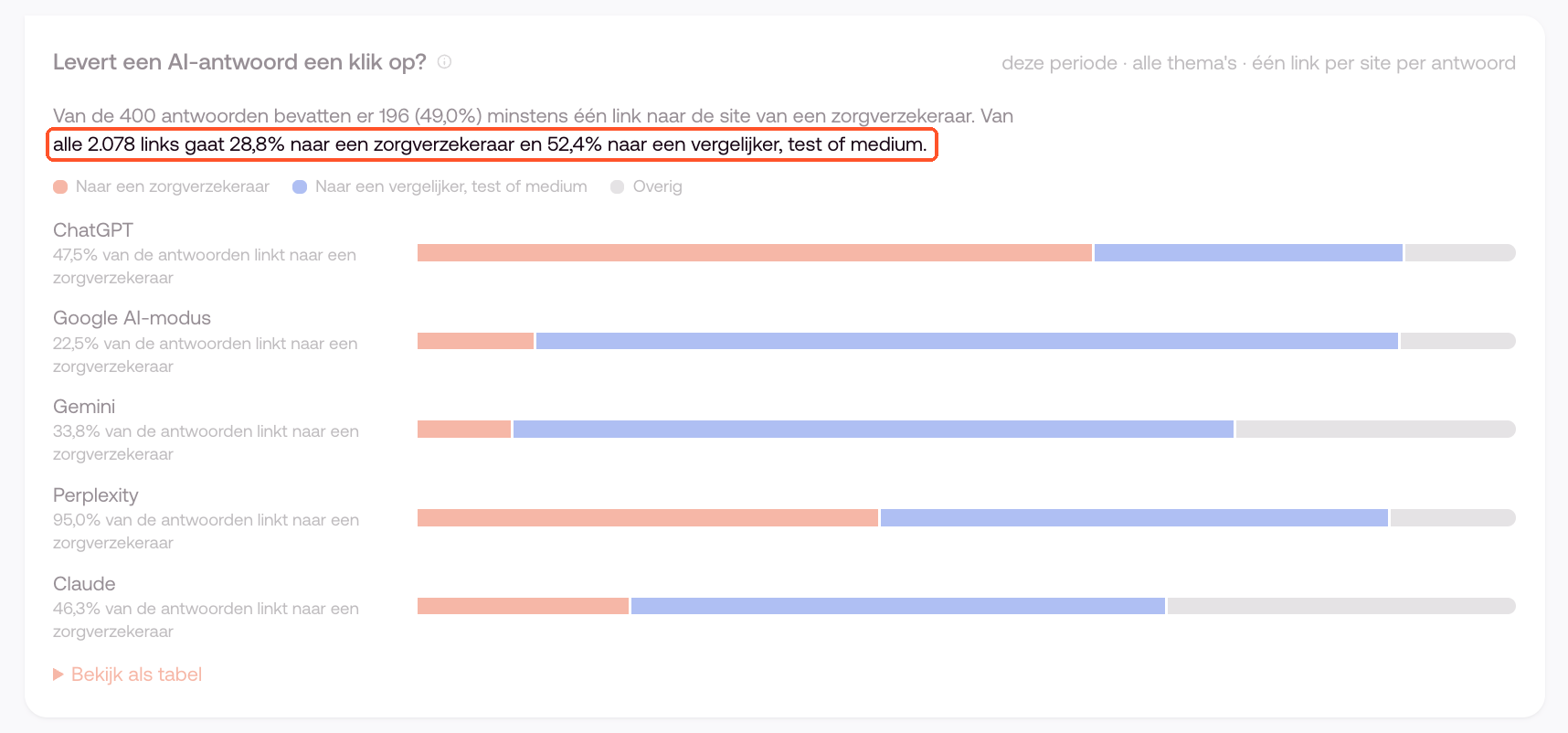
Where the 2,078 links in the AI answers go: 52.4% to a comparison site, testing organisation or media outlet and 28.8% to a health insurer.
DSW isn't in Google's top 10 for any of the search terms we track, yet it leads in AI. When AI mentions DSW, it often cites its customer rating from comparison sites.
So a large part of your influence lies outside your own channels: in your ratings on comparison sites, in test results and in articles about you.
How do you improve your AI visibility?
You want to know what your reputation with AI is and how AI presents it. Measure that first, then get to work:
-
Look at how often AI names you and whether it's positive when it does.
-
Look at which sources AI uses when it talks about you.
-
Compare per assistant and per situation, because the answers differ.
-
Choose what you want to excel at, the way DSW leads on service and Vinkvink on price.
-
Follow your position over a longer period. From 14 November the dashboard compares periods. You'll see whether a change shows up in the answers and notice when a competitor overtakes you.
Then you know where to work: on your own website and on the sites AI reads.
How does WUA measure AI visibility?
We first built this for WUA itself, to understand what works when you optimise for an AI assistant. We tested a range of generative engine optimisation (GEO) tools and adopted what worked best. None of those tools gave a benchmark. So we built one ourselves.
One AI answer says nothing. Every assistant gives its own answer. That answer also changes with the situation of the person asking. Only across many answers do you get reliable percentages.
This is how our AI Visibility Benchmark is set up:
-
Five assistants: ChatGPT, Google AI Mode, Gemini, Perplexity and Claude.
-
Ten questions from our research into how people choose a health insurer.
-
Each question in four situations: with no situation, as a healthy student with a high deductible, as a family with children and as someone with a chronic illness and regular healthcare providers.
-
Clean sessions with no account or memory, as close as possible to the answers a user sees in the app.
-
Figures over the last 28 days, updated every day.
The difference is big. With no situation, AI names DSW in 46% of answers. Asked as the student, it's only 22%.
Why does AI visibility weigh as heavily as what customers think?
WUA benchmarks companies and shows why one player does better than another. How you do in the eyes of an AI assistant matters just as much as how you do in the eyes of your audience. That AI assistant comes to stand between you and your audience. The better you give it what it needs to inform your audience well, the better you perform.
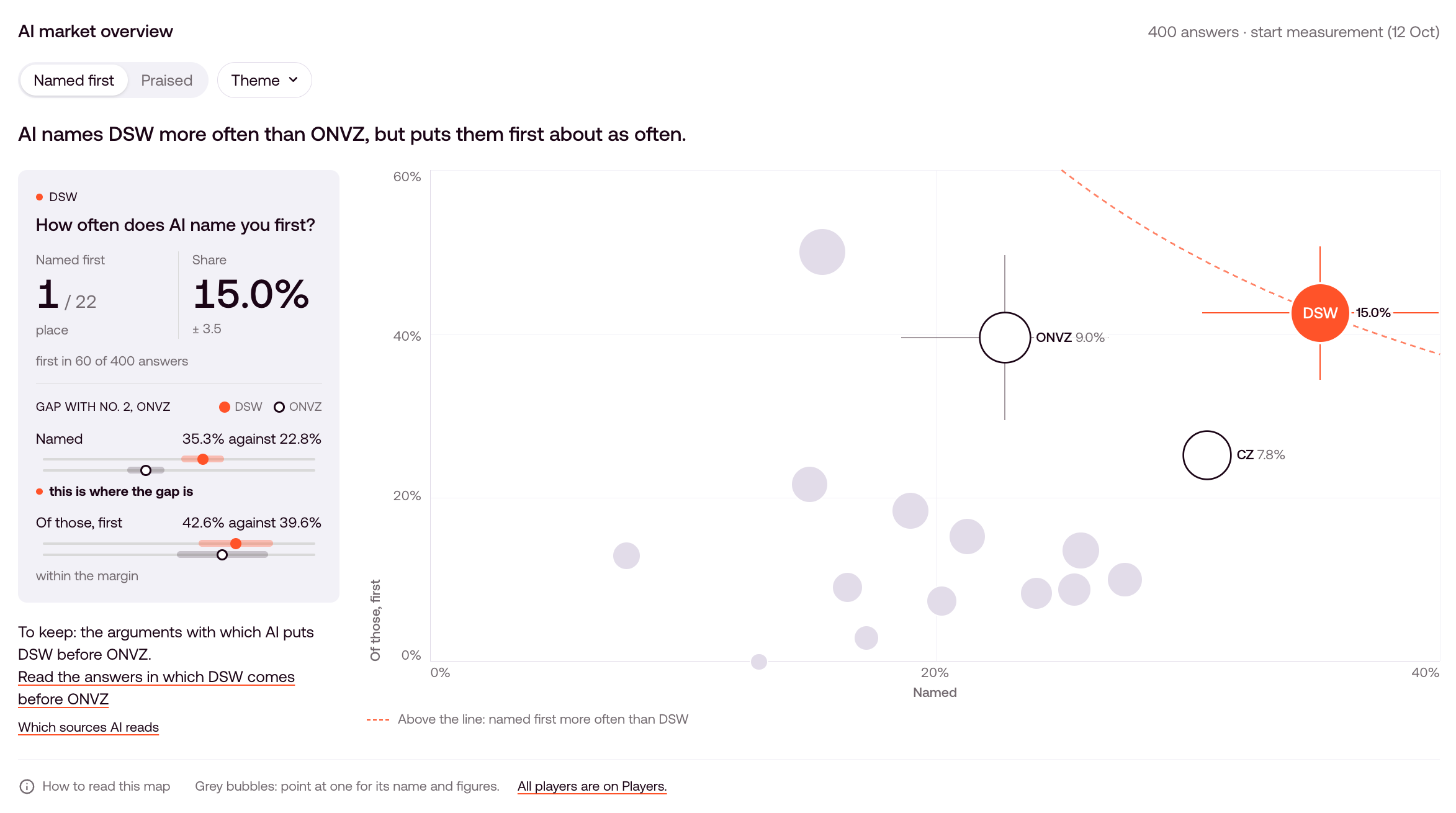
The market overview in WUA's AI visibility benchmark: DSW is in place 1 of 22 and is named first in 15% of answers.
Create a free myWUA account and see in the dashboard where your own brand stands: how often AI names you per theme and per assistant, whether it's positive about you and which sources it uses.
Car insurance, home insurance, mortgages, energy and telecom are coming soon. Active in one of those markets? Sign up for our newsletter and be the first to hear when your sector is added.