KPN is the internet provider AI names most often: in 84% of 399 answers from five AI assistants. But the provider AI names first most often is Solcon, a much smaller name. The reason tells you a lot about this market. When you ask AI about internet and TV, it doesn't just list providers. It grades them, using the Consumentenbond's test, and it adds a critical note far more often than in any other sector we measure. See where your own brand stands in the free dashboard.
The top 10 internet providers according to AI
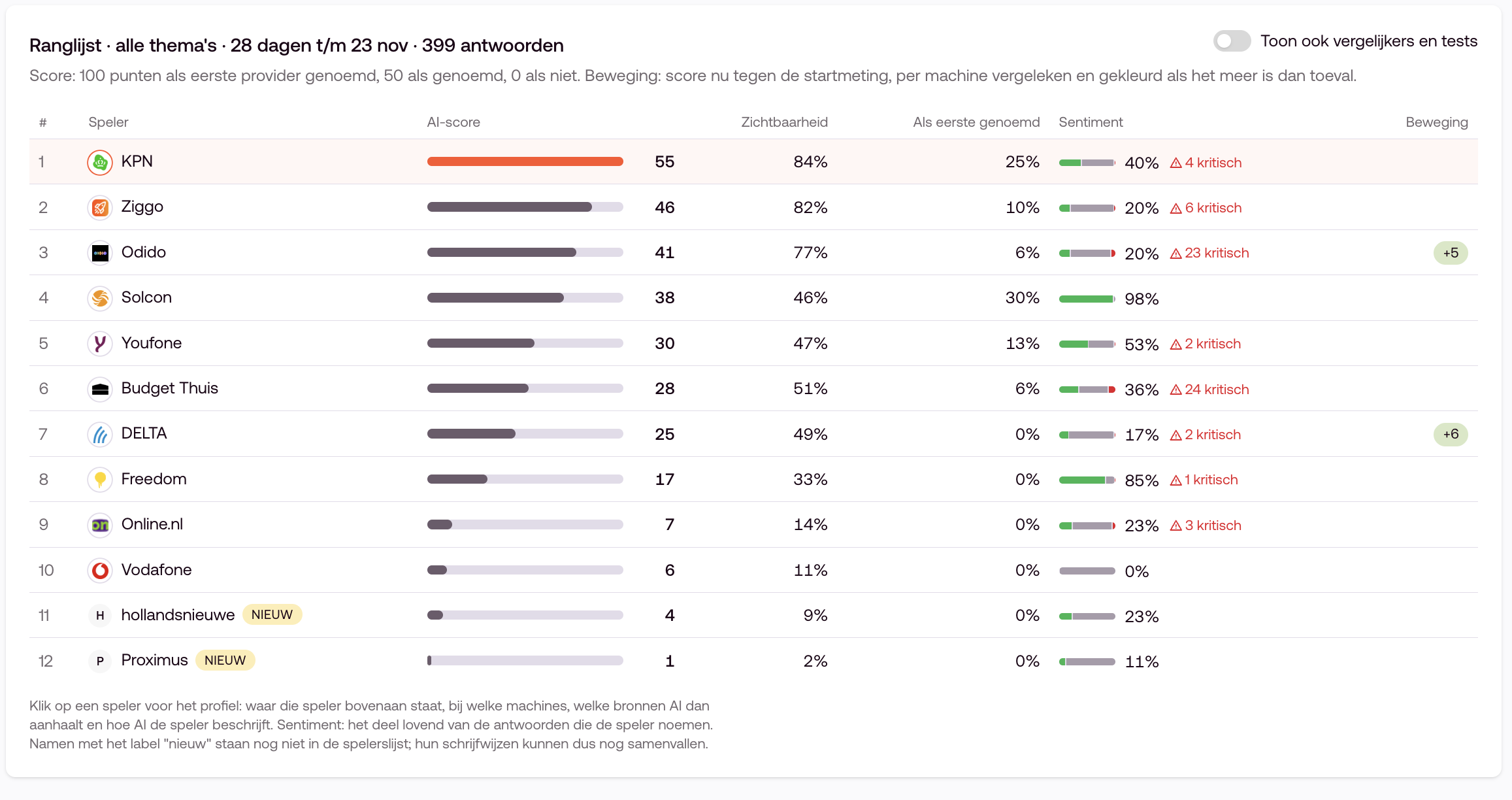
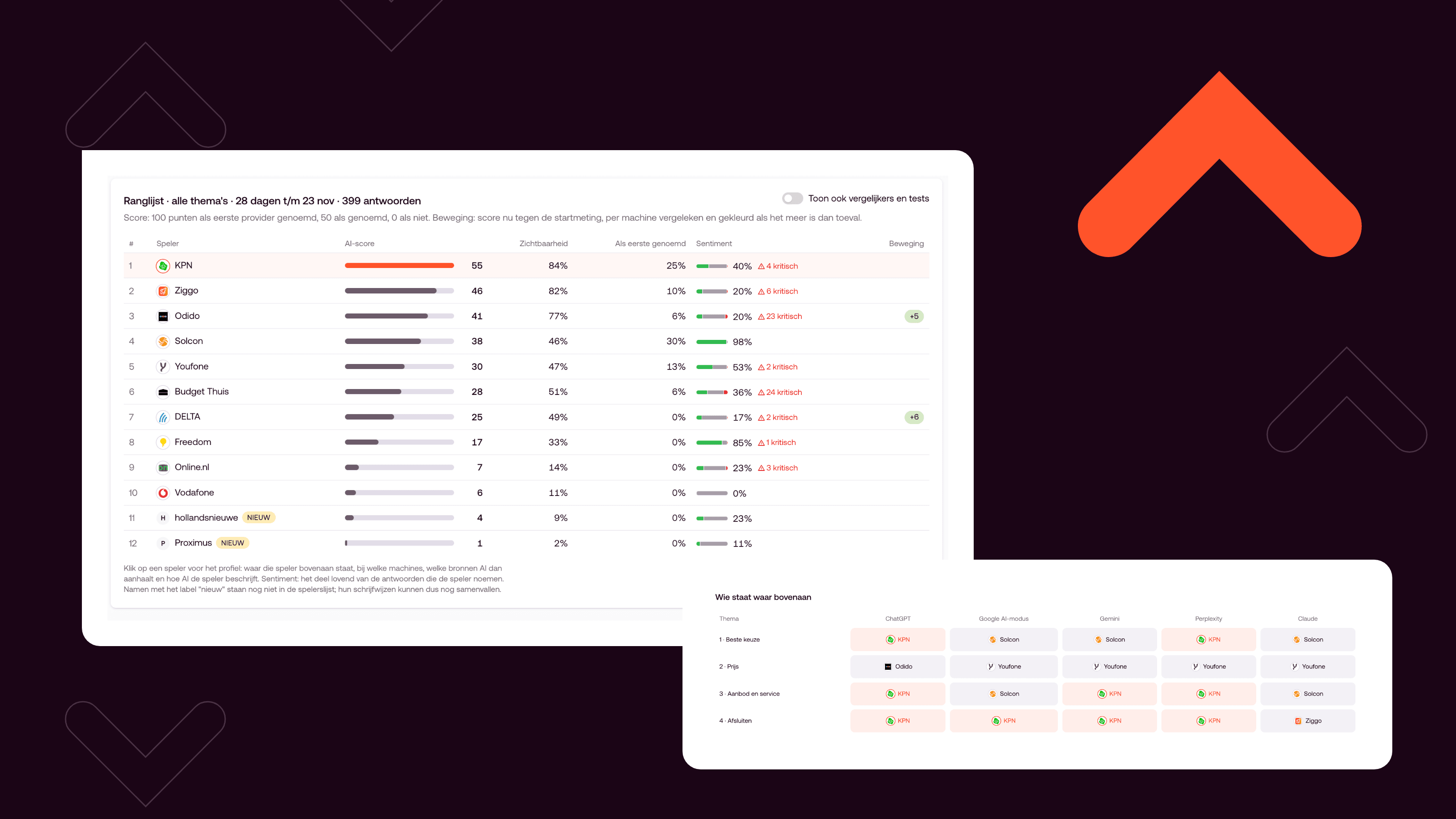
The ranking in WUA's benchmark for AI visibility: 399 answers from ChatGPT, Google AI mode, Gemini, Perplexity and Claude over the 28 days up to 23 November 2026. Places close together fall within the margin of ±4 points. Only ten providers have enough answers for a ranking, so this is a top 10.
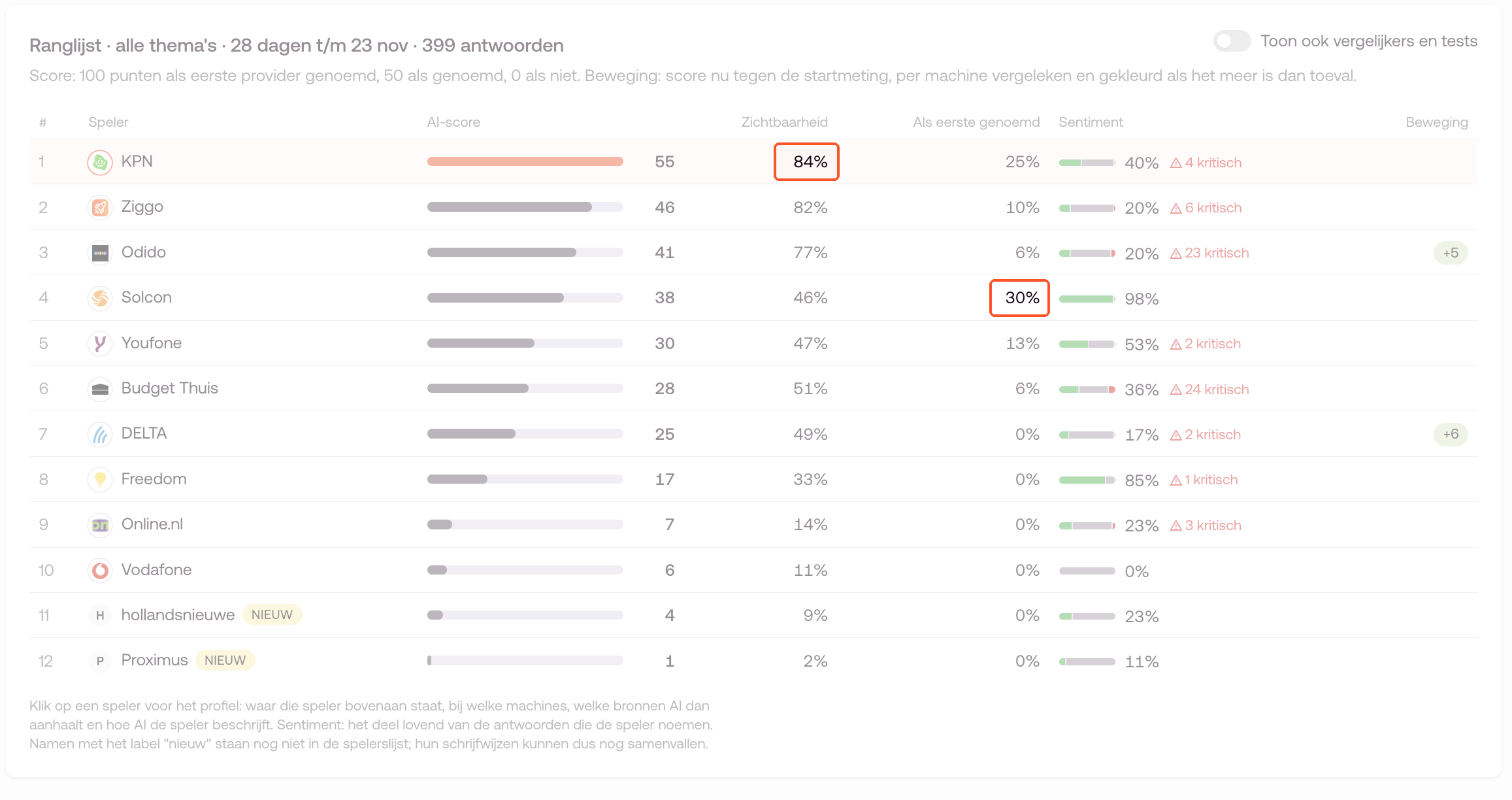
The league in the dashboard (Players tab). Marked: KPN is named in 84% of the answers, Solcon is named first in 30%.
Where does your brand stand?
This list is the average over every question and every assistant. In the free dashboard you see your own brand per question, per assistant and per customer situation, whether AI praises you or is critical, and every answer it gave about you, word for word.
Key findings
From WUA's benchmark for AI visibility of Dutch internet and TV providers, 399 answers, 28 days up to 23 November 2026:
-
KPN is named most, Solcon is named first most. AI names KPN in 84% of its answers and puts Solcon first in 30%, more often than any other provider.
-
AI is more critical about internet providers than about any sector we measured so far. It made 64 critical remarks about providers, against 26 about energy suppliers and 11 about health insurers in the same period.
-
The Consumentenbond test drives it. The Consumentenbond comes up in 66% of the telecom answers, against 42% in energy and 33% in health insurance, and in 40 of the 44 answers with a critical remark.
-
Ranking in Google doesn't decide what AI says. DELTA is in Google's top 10 for 3% of the search terms and for none of the ten questions, yet AI names it in 49% of its answers.
Why is AI more critical about internet providers?
Because it quotes report cards. The Consumentenbond tests internet providers every quarter and gives each one a grade, for service, for outages and overall. AI leans on that test far more in telecom than elsewhere: it comes up in 66% of the answers, against 33% for health insurers. And a list of grades has a bottom. When AI copies the list into its answer, the low grades come along, and with them a line like "scores lower on customer service".
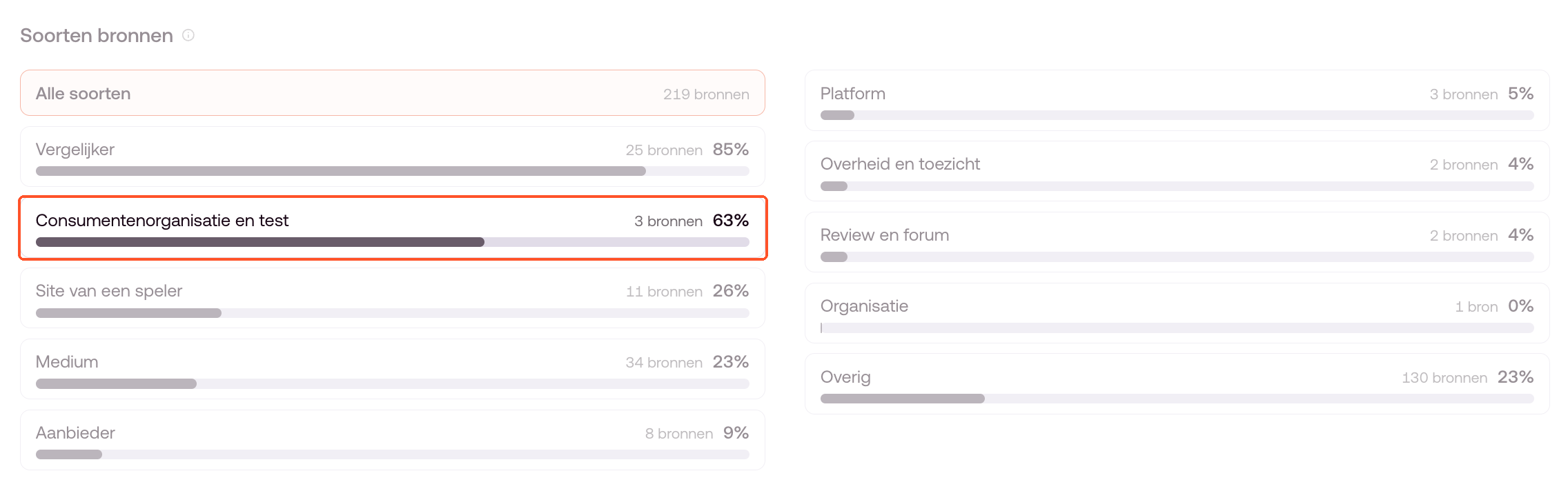
Sources and tips, "Kinds of sources": consumer organisations and tests are cited as a source in 63% of the answers. Counting every mention in the text, the Consumentenbond comes up in 66%.
You can see it in which questions get the criticism. Two questions carry more than half of it: "Which provider has the best service and helps fastest with outages?" and "Which providers get the best customer reviews?". Both ask for a judgment, so AI goes looking for scores. A question about price gets a price list. Those questions get almost no criticism at all.
It also depends on who you ask. ChatGPT was critical in one of its 80 answers, Google AI mode in 14 of 79. Google AI mode puts the test grades into its answer about twice as often.
To be clear: criticism is still the exception. When AI names a provider, it praises it 39% of the time and is critical about 3% of the time. But in telecom, a "but" comes along much more often than in other markets.
Why does a smaller provider get named first?
Solcon is named in fewer than half of the answers, yet AI puts it first more often than KPN. In 118 of the 119 answers where Solcon comes first, AI mentions the Consumentenbond, usually with the grade itself. Solcon tops that test, and AI repeats it whenever someone asks who is the most reliable, who has the best service or who gets the best reviews.
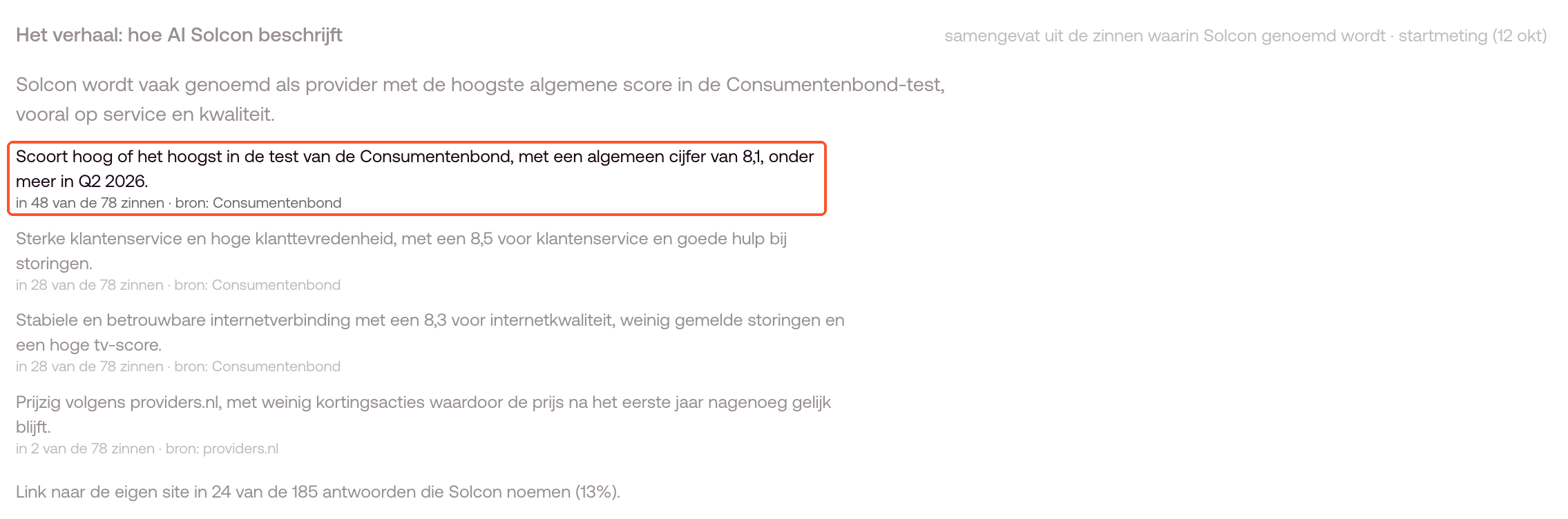
Players, Solcon, "The story": in 48 of the 78 sentences about Solcon, AI repeats its Consumentenbond grade. This summary is from the start measurement (12 October); the figures in the text are for the 28 days up to 23 November.
That's also why Solcon leads on Google AI mode and Claude and much less on ChatGPT: the assistants that quote the grades put the test winner first.
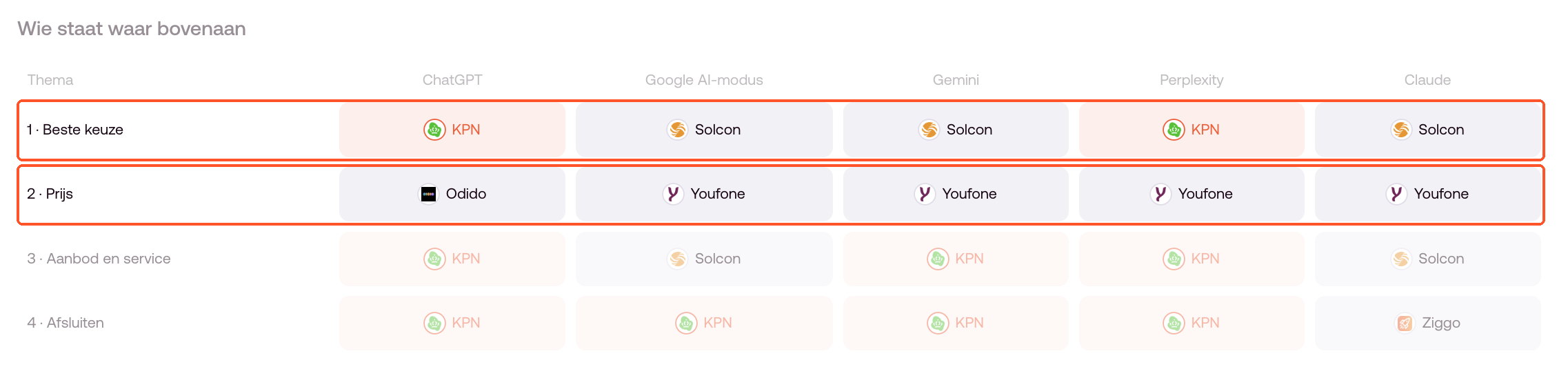
Players, "Who leads where": on the best choice, Solcon leads on three of the five assistants. On price, Youfone leads on four.
Other questions have other winners, because each one sends AI to a different source:
| The question | What AI looks for | Where it finds it |
|---|---|---|
| Most reliable, best service, best reviews? | A test grade | The Consumentenbond |
| Which provider is the cheapest? | This month's price | Overstappen.nl, Breedbandwinkel, Pricewise |
| Where do I take out a subscription online? | Whether fibre reaches your address | An address check, often on the provider's own site |
On price, Youfone wins: 30 of the 51 times AI names it first are on "Which provider is the cheapest?", because the comparison sites call it the cheapest. One answer even notes that Breedbandwinkel named Youfone the cheapest provider again in November.
Does ranking high in Google help?
Less than you'd think. DELTA shows it best. It's in Google's ordinary top 10 for 3% of the search terms we track and for none of the ten questions, yet AI names it in 49% of its answers.
The reason is what each one counts. Google's top 10 lists pages, so you're only in it when one of your own pages ranks. AI names brands, wherever it read about them. It knows DELTA from comparison sites and rankings, such as Keuze.nl's ranking on lowest price, and as the fibre provider in many regions outside the big cities.
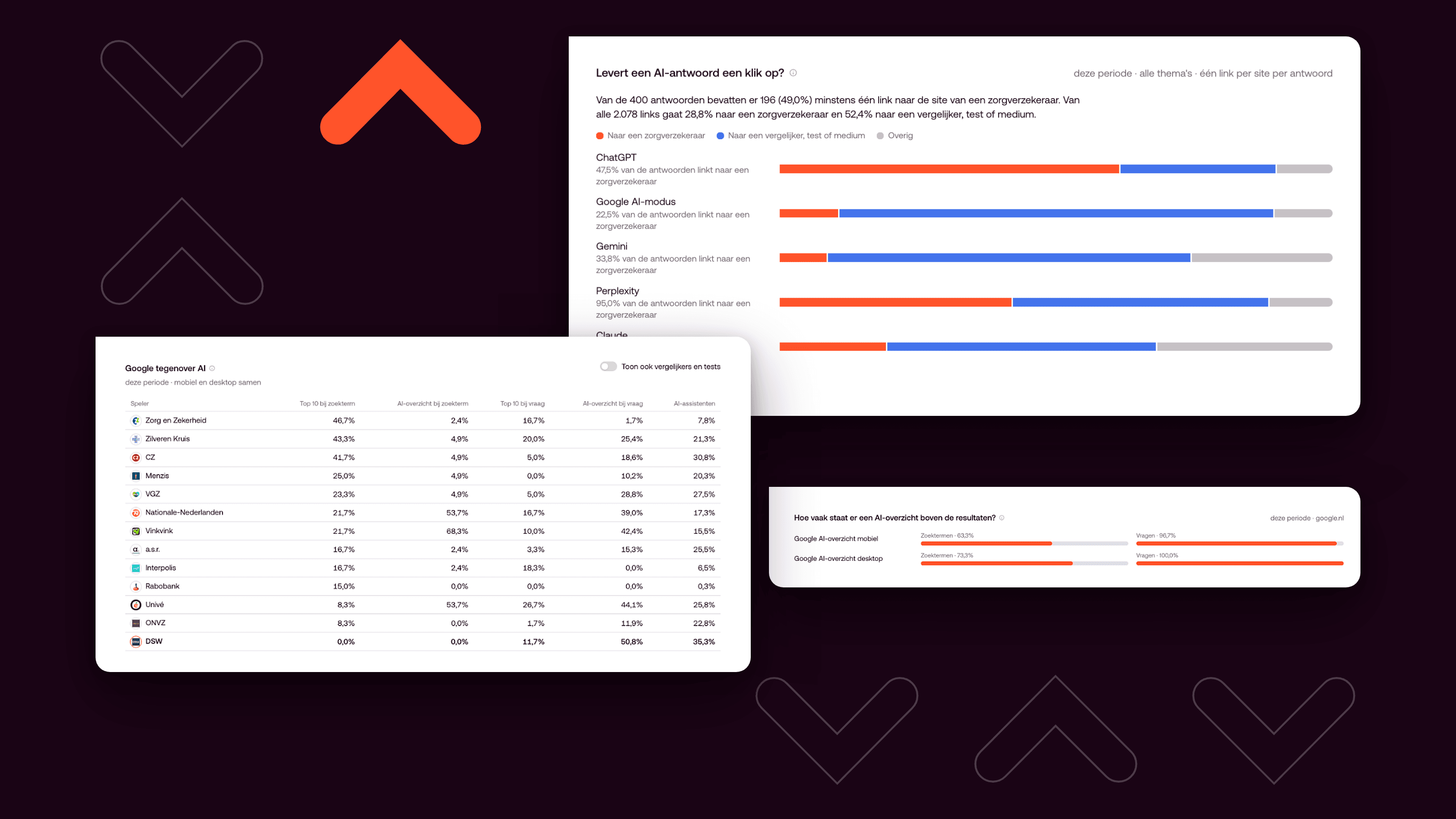
Google's own AI overview works like the assistants. It sits above the results for 93 to 100% of these searches, and it names DELTA for 47% of the questions, about as often as the AI assistants do. So on one results page, the AI answer at the top can name a provider that the links below never show.
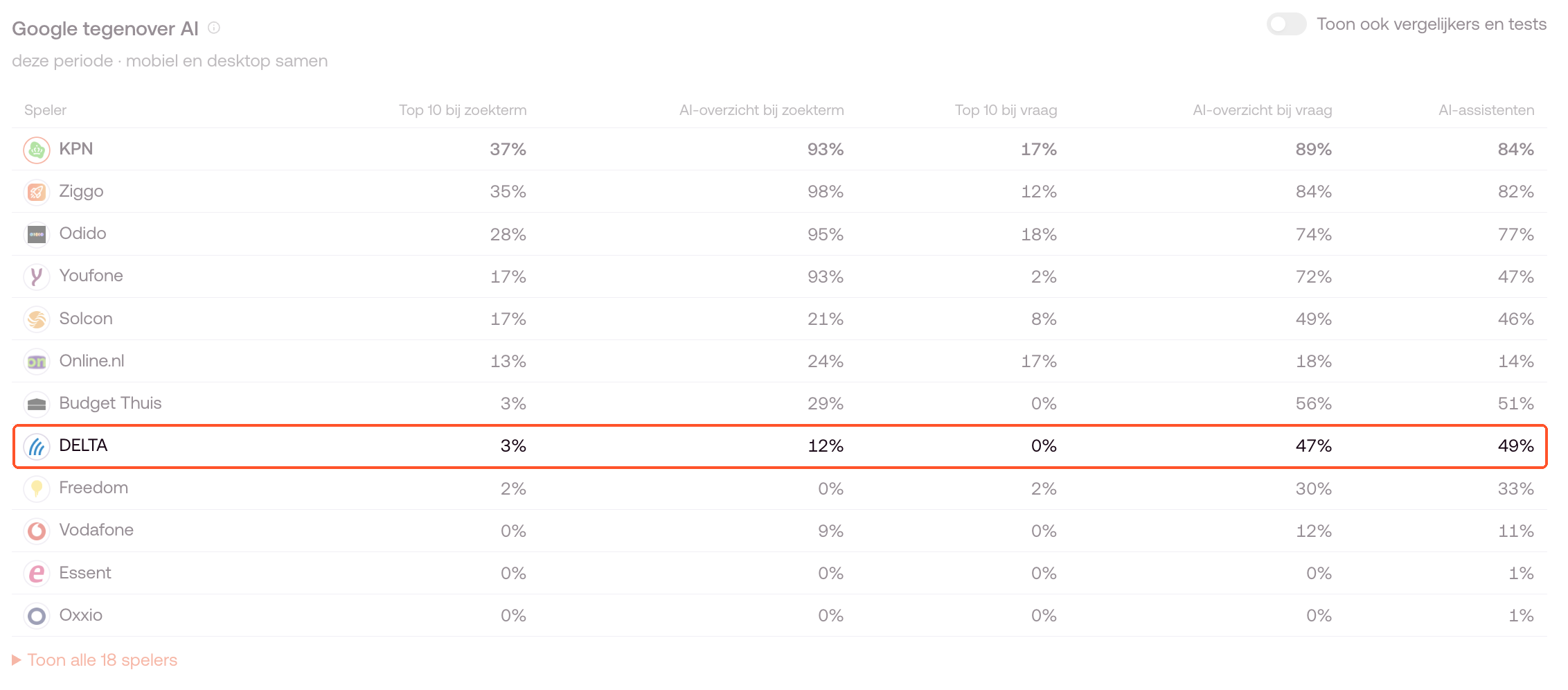
Google tab, "Google against AI": DELTA is in the top 10 for 3% of the search terms and 0% of the questions, in Google's AI overview for 47% of the questions and in 49% of the AI assistants' answers.
How do you get named more often?
Positions in AI answers move within weeks: since the start measurement on 12 October, DELTA has gained 6 points and Odido 5. Three things help:
Find out what AI says about you, and where it got it. Read the answers about your brand and check them against the facts. When something is wrong or outdated, fix it at the source AI used, not just on your own site. Sometimes that source is your own site: we've seen AI quote a company's terms from two years ago because the old page was still easy to find.
Get onto the pages AI reads. 85% of the answers cite at least one comparison site, and only 10% of the links in the answers go to a provider's own site. In this market, the Consumentenbond test and the comparison sites decide what AI says about you. Check what they say for the question you want to win.
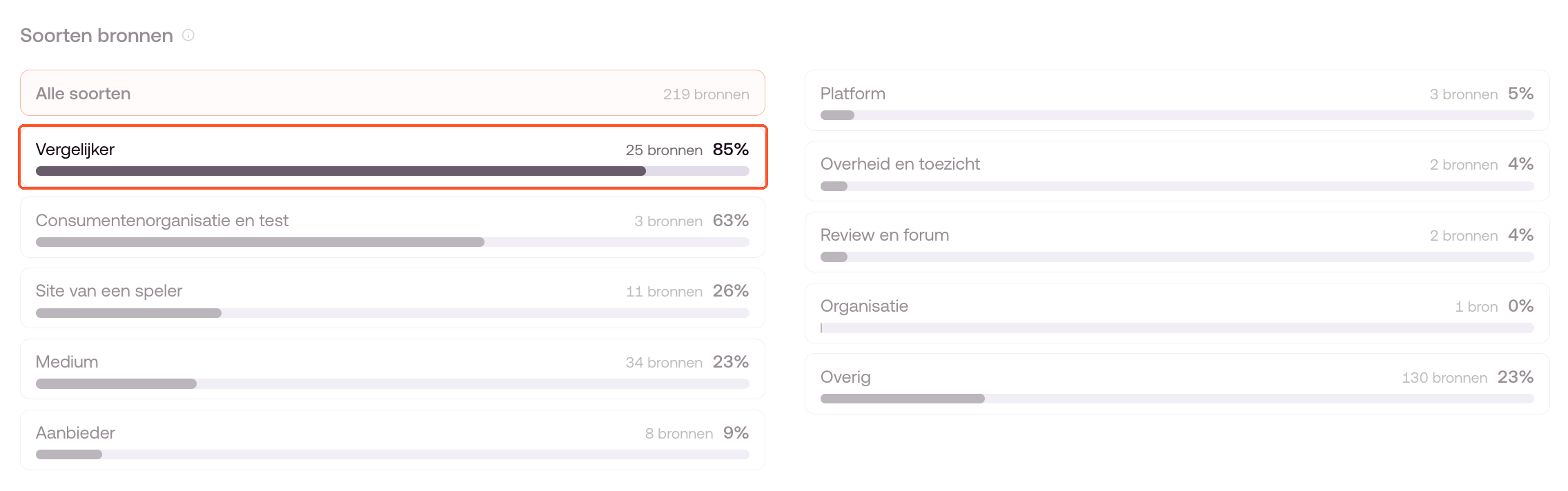
Sources and tips, "Kinds of sources": 85% of the answers cite at least one comparison site.
Make your current facts the easiest ones to find. AI can't tell which of two pages is current unless you make it obvious. Put your latest test result, price and terms on one page, dated, and say the same thing everywhere. When your site and the comparison sites agree, AI repeats it. When they differ, AI picks one.
See what AI says about your brand
With a free account you get the full benchmark in myWUA, updated every day. For your own brand you see:
-
your score on each of the ten questions, from reliability to switching
-
how you do per assistant and per situation, including people whose contract is ending
-
whether AI praises you, names you neutrally or is critical, sentence by sentence
-
which tests and comparison sites AI quotes when it talks about you
Already have a myWUA account? Log in and you'll find the benchmark there.
How we measured
We put ten fixed questions, based on WUA research into how people choose an internet and TV subscription, to ChatGPT, Google AI mode, Gemini, Perplexity and Claude. Each question is asked plainly and from three situations: someone moving to a new address, a family that works from home and streams, and someone whose contract is ending. The questions range from "Which internet provider is the most reliable?" to "Where can I take out an internet and TV subscription quickly and easily online?"
Frequently asked questions
What is AI visibility?
How often, and how, an AI assistant names your brand when someone asks it for help with a choice: whether you're in the answer, whether you're named first and what AI says about you.
How often do you measure?
Every day. The figures always cover the last 28 days, so they move along with what AI says, and every period is compared with the one before.
How is the AI score calculated?
A brand gets 100 points when AI names it first, 50 when it's named and 0 when it's missing. The average is the AI score. It shows visibility only and says nothing about how many people then pick you.
Why does a position change from day to day?
AI doesn't give the same answer twice. That's why we count over hundreds of answers, from clean sessions without an account or history, and only mark a change when it's bigger than chance.
What does "critical" mean?
An answer counts as critical only when it is clearly negative about the brand itself, with no plus beside it: a weakness, complaints, a low score or advice against it. A plus and a minus in one sentence count as neutral. A language model reads the answers with fixed definitions, and a person checks it: in a blind test they agreed on 33 of 40 sentences.
We cover a new sector every week. Get the newsletter to hear when yours is in.
 Newsletter