Ask an AI assistant which health insurer has the best customer reviews and you mostly hear DSW. Ask which one is cheapest and it's Vinkvink or Univé. CZ and VGZ come up for every theme we measure, and AI likes to add that they're one of the big four.
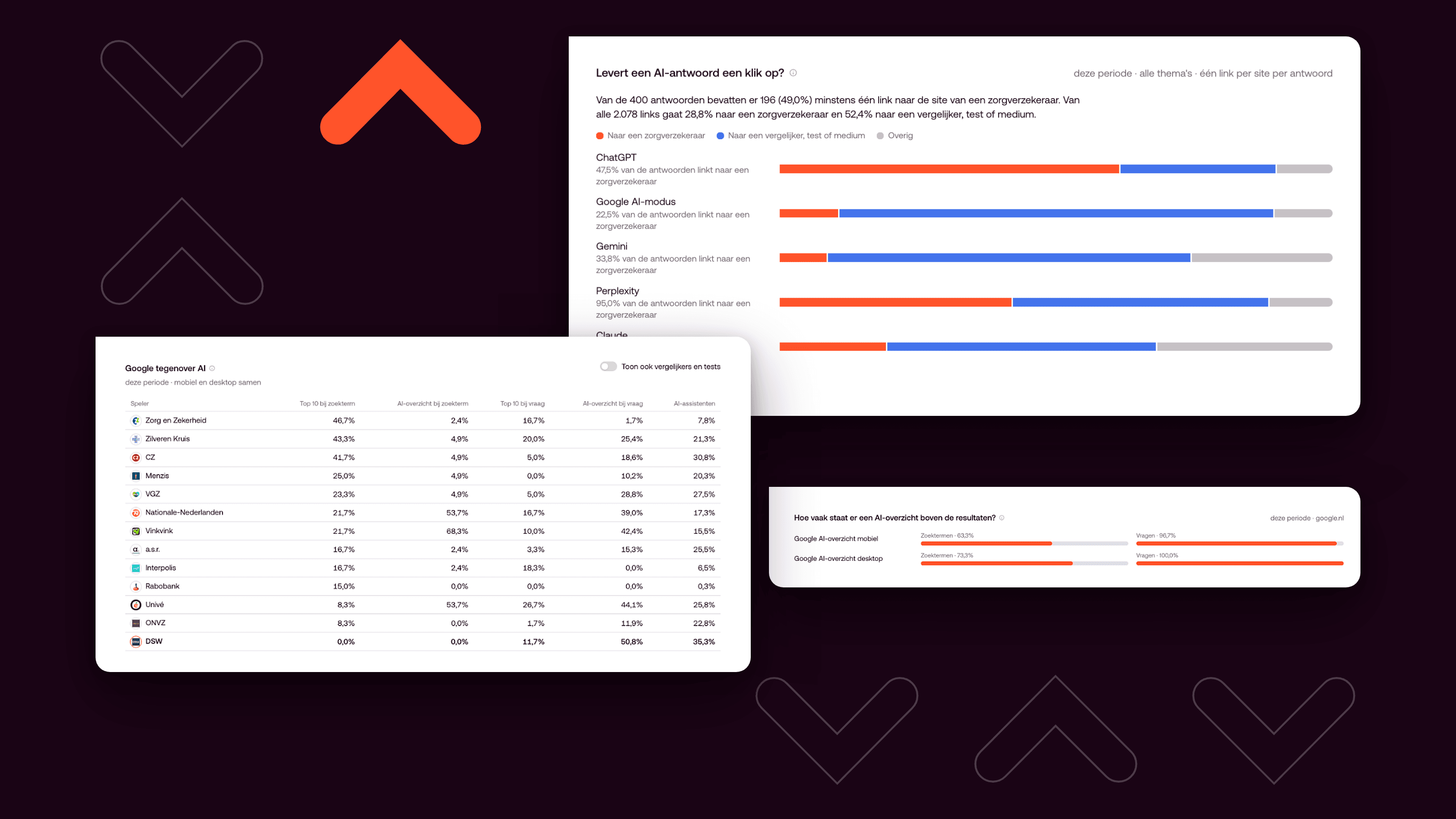
With the switching season in full swing in the Netherlands, we wanted to know why AI names these insurers in particular. Even on Google, people looking to switch now see an AI answer first: for 96.7% of our questions on mobile and 100% on desktop, Google puts its own AI Overview above the search results.
So since 12 October we've been asking five AI assistants the questions people ask before they switch. Those answers give insights you can act on right away.
The key findings
From WUA's AI visibility benchmark for Dutch health insurers: 400 answers from ChatGPT, Google AI Mode, Gemini, Perplexity and Claude, start measurement October 2026.
-
DSW is the health insurer AI names most often. AI names DSW in 35.3% of answers and as the first insurer in 15%.
-
No insurer appears in more than half of the answers. Even number one, DSW, is missing from 64.7% of AI answers.
-
AI links to comparison sites more often than to insurers. Of the 2,078 links in the answers, 52.4% go to comparison sites such as Zorgwijzer and Independer, the Dutch consumer association Consumentenbond or the media, and 28.8% go to a health insurer.
-
Zorgwijzer is AI's most important source. Zorgwijzer is cited in 61.5% of all answers.
-
A strong position in Google doesn't carry over to AI. DSW leads in AI, but isn't in Google's top 10 for any of the search terms we track.
-
AI praises some insurers far more often than others. AI is positive about DSW in 71.6% of the answers that mention DSW. For VGZ, that's 11.8%.
What is AI visibility?
AI visibility is how often and how an AI assistant mentions your brand when someone asks a question that leads to a choice. We look at three things: whether your brand is in the answer, whether AI names you as the first insurer and how it writes about you.
How did we measure it?
We asked ChatGPT, Google AI Mode, Gemini, Perplexity and Claude ten fixed questions in Dutch. They come from WUA research into how people choose a health insurer: what they search for, what weighs most in their choice and the moment they switch. Every answer comes from a "clean session", with no account or memory.
We asked each question in four ways:
-
with no situation
-
as a healthy student with a high deductible
-
as a family with children
-
as someone with a chronic illness and regular healthcare providers
An insurer gets 100 points if AI names it first, 50 if it's mentioned and 0 if it's missing. That AI score says something about visibility, not about the chance that someone will choose you. Every day we ask part of the questions again. The ranking always covers the last 28 days, so it moves with what AI says.
We're starting with health insurers. Car insurance, home insurance, mortgages, energy and telecom are coming soon. Active in one of those markets? Sign up for our newsletter and be the first to hear when your sector is added.
The top 15 health insurers according to AI
The number one is a smaller insurer. Google AI Mode even counts DSW among the "independent players", next to large groups like Achmea, CZ, Menzis and VGZ.
Even as number one, you're only mentioned in about one in three answers. No insurer appears in almost every answer, so the top of this ranking is still wide open.
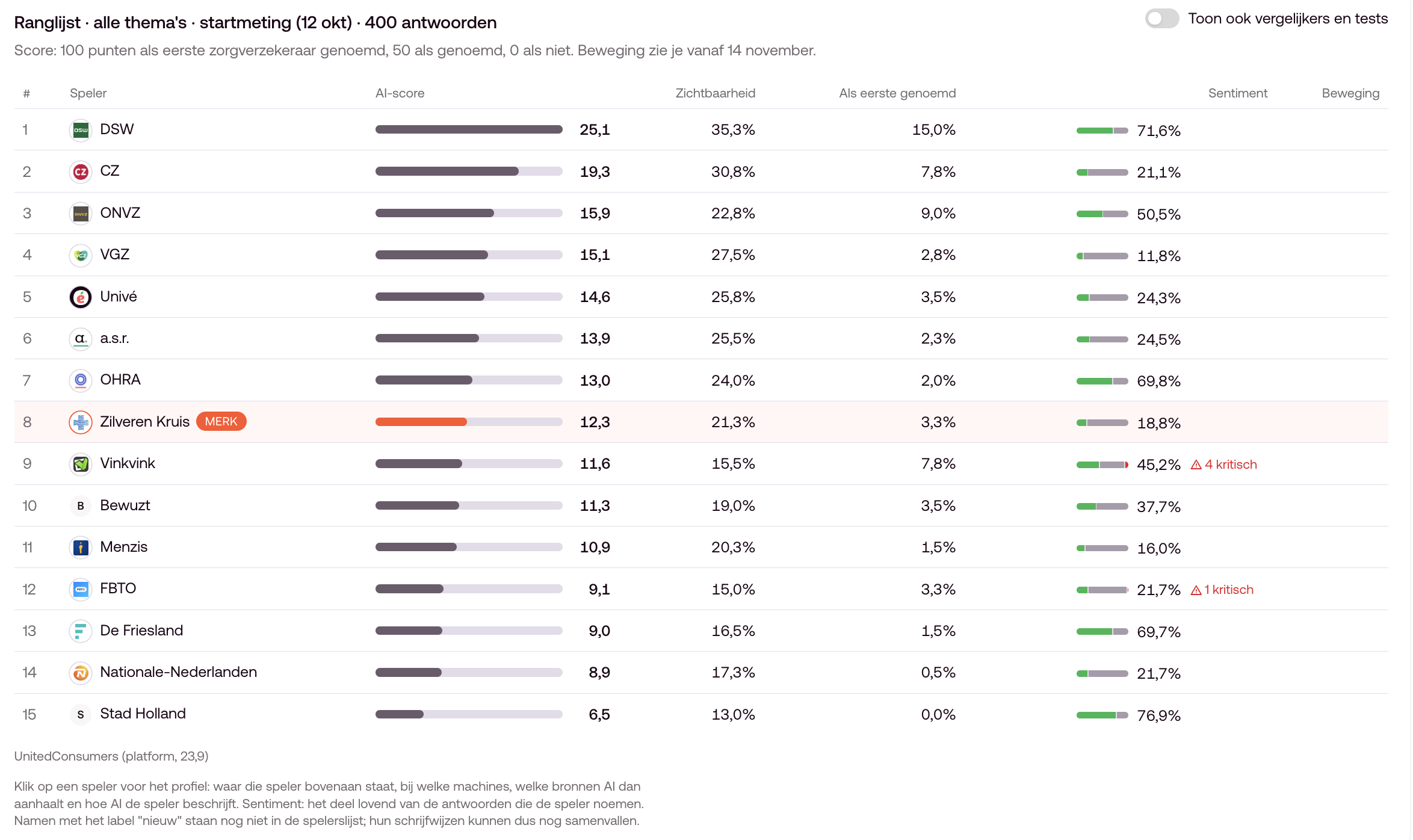
WUA's AI visibility benchmark, 400 answers from five AI assistants, start measurement October 2026. Places 3 to 8 are close together.
Want to see where your own brand stands, per assistant and per question?
It's all in the benchmark, with a free account.
How does a health insurer end up in an AI answer?
Which insurers make it in depends on what the assistant reads. In the answers, we see three ways.
1. A customer rating AI can repeat
When AI mentions DSW, OHRA or ONVZ, it often adds their score from a customer satisfaction ranking. For DSW that's an 8.8 or 8.9, in 57% of the sentences AI writes about DSW. That rating comes from Zorgwijzer, ZorgkaartNederland, Overstappen.nl and Independer.
With that rating, DSW wins the questions about who's best. There DSW is the clear leader, while other insurers lead on price and switching. DSW's first place comes from that one type of question.
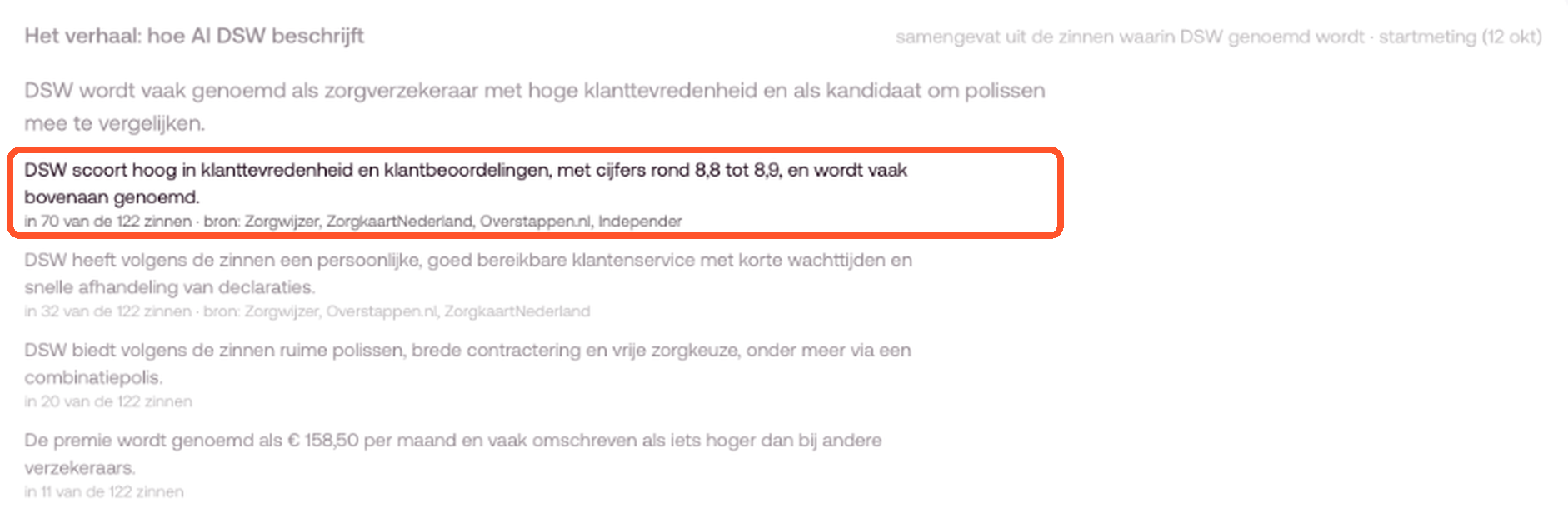
How AI describes DSW, summarised from every sentence that mentions DSW.
2. A fact that answers one question
Univé, Vinkvink and Nationale-Nederlanden come in through one question, with a policy name and an amount. Ask which policy is cheapest and Vinkvink is at the top, followed by Univé and Nationale-Nederlanden. In half of what AI says about Univé, it mentions Zorg Select with a premium of €125.40 a month. ONVZ and a.s.r. do the same for free choice of healthcare provider, with policies like Vrije Keuze and Eigen Keuze.
That's another way to be named first. Vinkvink appears in 15.5% of answers, half as often as CZ, for example, but comes up first in 7.8%. That's just as often as CZ.
Ask which insurer is most reliable and DSW comes out on top, thanks to its customer rating of 8.8 or 8.9. Vinkvink, for example, scores ten times lower there, purely because it doesn't have a customer rating AI can find.
3. Being big, or looking big
CZ is mentioned in 30.8% of all answers and VGZ in 27.5%. CZ comes first in 7.8%, VGZ in 2.8% and Menzis in 1.5%. AI describes them as one of the big four, with most of the market and contracts with almost every hospital. That puts them on the shortlist to compare. AI rarely goes further.
The praise goes to their labels. AI describes Bewuzt and UnitedConsumers, both owned by VGZ, as having sharp premiums and high customer ratings. Vinkvink belongs to Menzis and is called the cheapest policy.
How does AI talk about each insurer?
Being mentioned is only the first step. People who switch ask AI for a few options and read what AI says about each one. If AI mentions a high customer rating or a clear strength, it gives the reader a reason to choose you. If you're only listed, you stay a name on a list. That's why how AI talks about you is a dimension of AI visibility in its own right, next to how often it names you.
The ranking shows how often AI names you. The "Praised in" column shows what AI thinks of you. That's a different list. AI is positive about DSW in 71.6% of the answers that mention DSW and about OHRA in 69.8%. Both have a customer rating behind them. CZ is second in the ranking, but is praised in 21.1% of its answers. For VGZ, that's 11.8%.
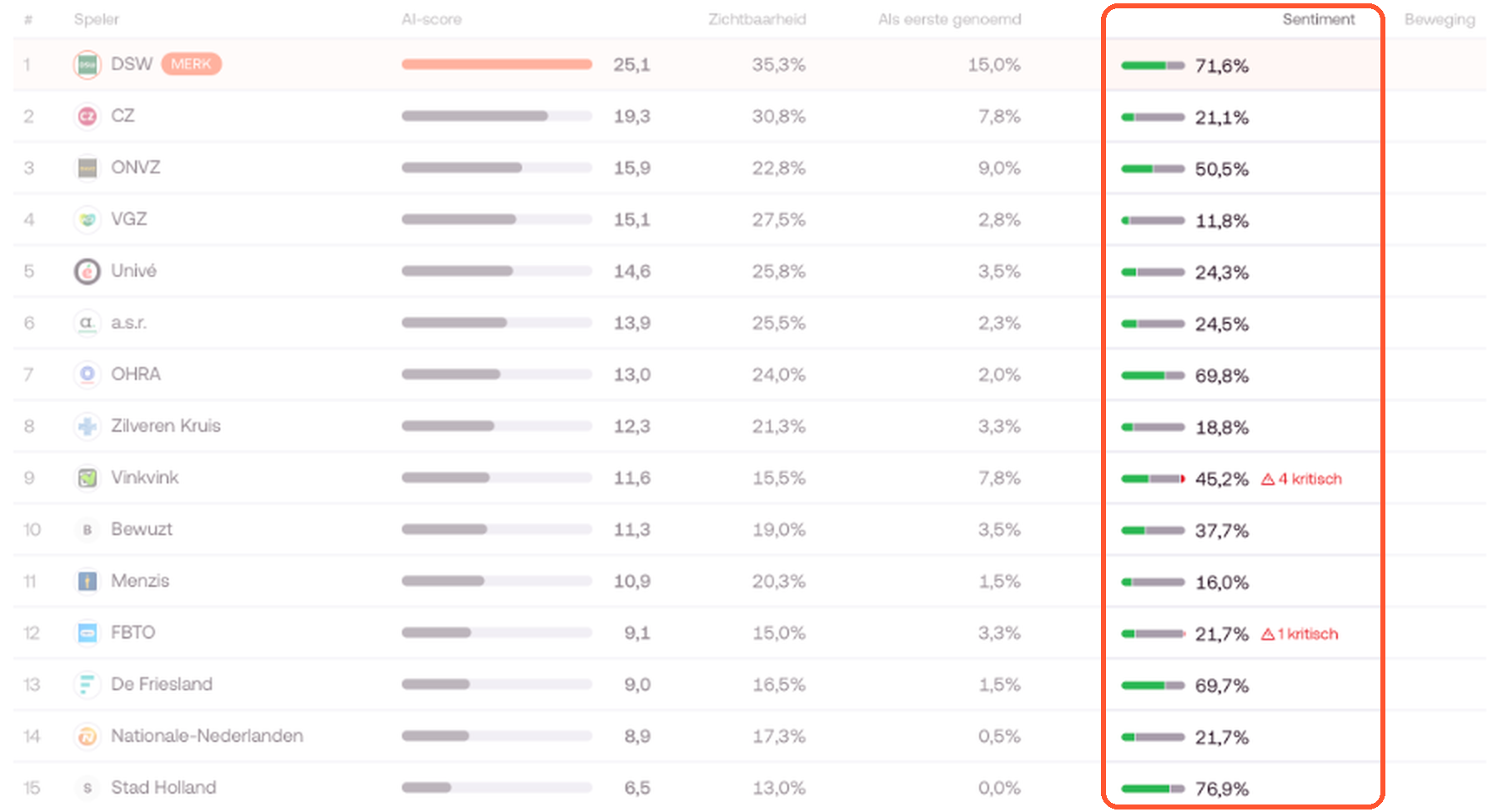
The ranking in the benchmark, showing per insurer how often AI praises it in the answers that mention it.
Lower down the list, it's the other way round. Stad Holland is fifteenth and gets the warmest words of all, in 76.9% of the answers that mention it. De Friesland, thirteenth, is praised in 69.7%. When AI mentions them, it's usually positive. AI just mentions them in fewer answers.
AI is rarely negative. Across the whole top 15, we found five critical answers, spread over two insurers. For most insurers, the question is whether AI praises them or just lists them.
Where does AI get its information about health insurers?
Mostly from comparison sites. More than 85% of answers include at least one comparison site or testing organisation such as the Consumentenbond. Zorgwijzer alone is cited in 61.5% of answers (246 of the 400).
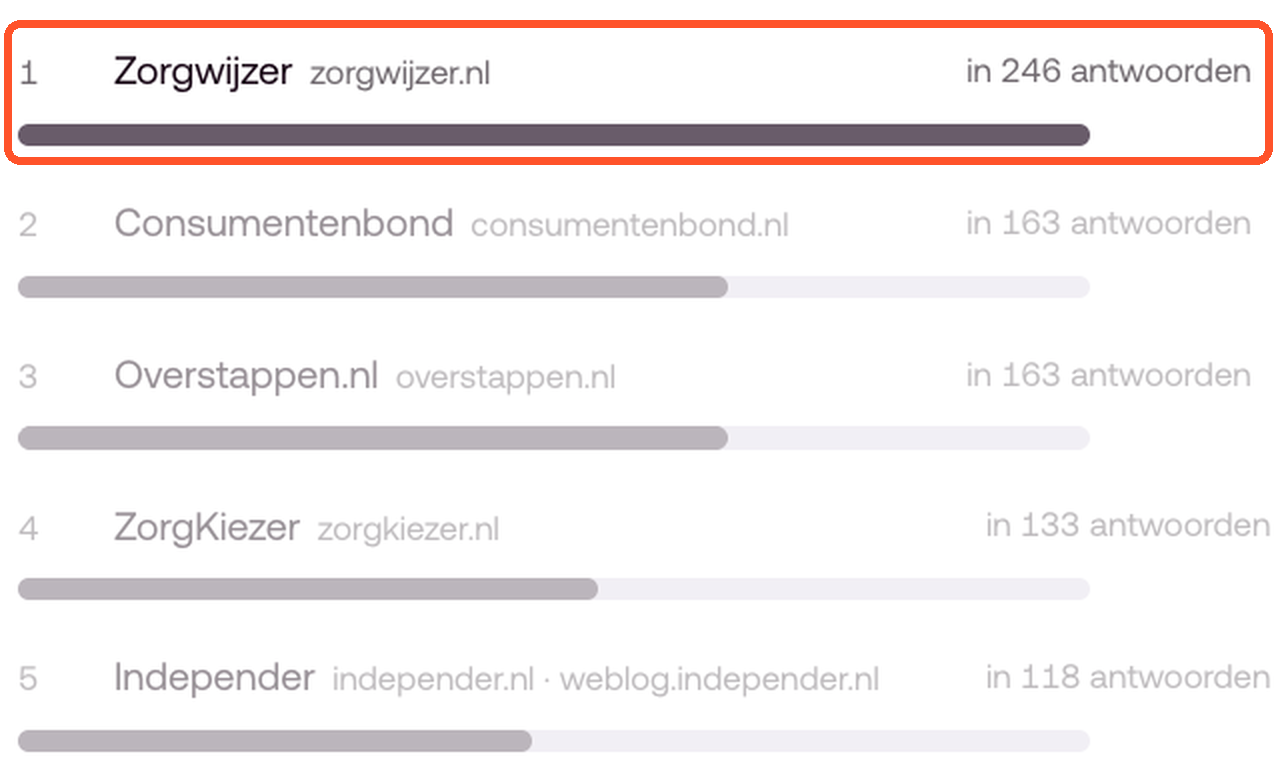
The five sources AI cites most in its answers about health insurers.
Of all 2,078 links in the answers, just over half go to comparison sites such as Zorgwijzer and Independer, the Consumentenbond or the media.
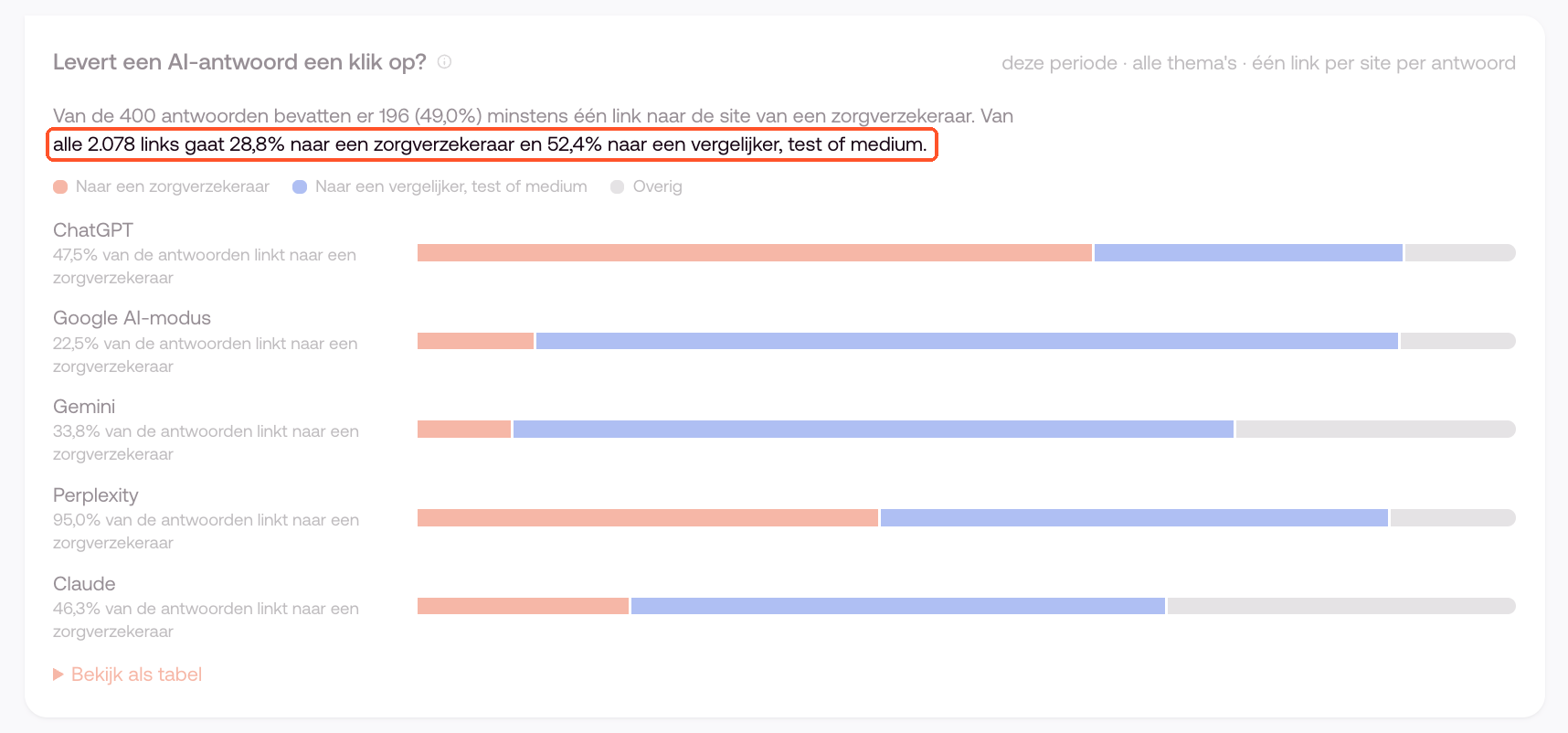
AI also reads insurers' own websites, mainly for details about policies such as physiotherapy and dental cover. But DSW's first place rests mostly on what other sites write about DSW.
Why doesn't a high position in Google carry over to AI?
Google's top 10 is a list of pages: you're in it when one of your own pages ranks well. In an AI answer, what counts is your name, wherever the assistant read it. DSW isn't in Google's top 10 for any of the search terms we track, yet it leads in AI. That's because the comparison sites the assistants read write about DSW.
For Zorg en Zekerheid, it's the other way round. Its own pages are in Google's top 10 for almost half (46.7%) of those search terms, but AI mentions Zorg en Zekerheid in only 7.8% of answers.
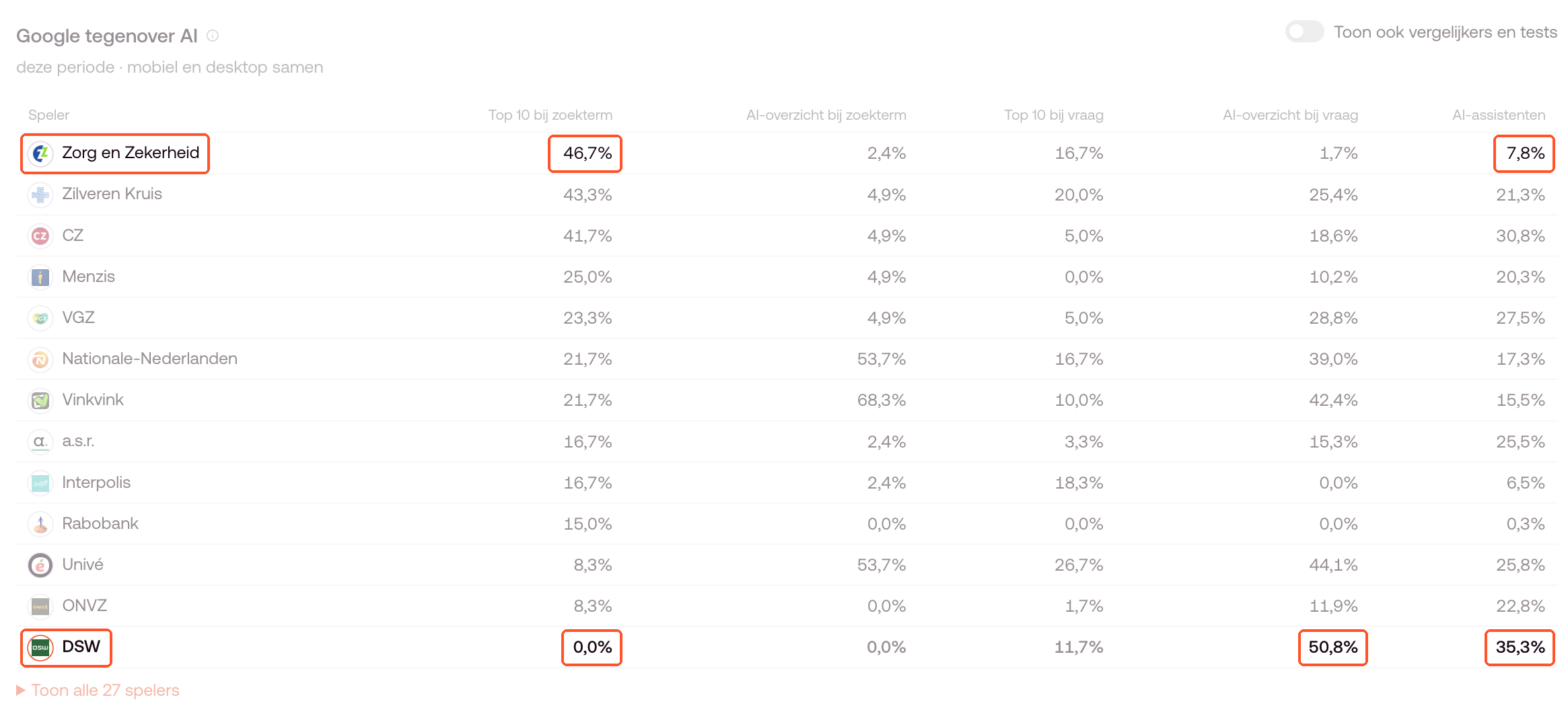
Per insurer, the position in Google next to visibility in AI assistants.
Google's own AI Overview shows the same pattern: DSW appears in half of the overviews Google gives for our questions.
Why do ChatGPT, Claude and other assistants give different answers?
The five assistants differ quite a lot. ONVZ does well in ChatGPT, but scores low in Google AI Mode. That's because each assistant reaches an answer in its own way. You can see it in what it links to.
ChatGPT links to an insurer's own site in 47.5% of its answers, Google AI Mode in only 22.5%. An insurer that's strong in one assistant's sources can score much lower in another.
The switcher's situation matters too. With no situation, DSW is mentioned in 46% of answers. As a "healthy student with a high deductible", that's 22%. So you don't have one position in AI, but a position per assistant and per type of switcher. Want to win a target group? Then make clear on your own site and on the comparison sites how your policy fits specific target groups.
How can a health insurer improve its position in AI answers?
From 14 November you can compare with the previous period. You'll see whether a change on your own site or on a comparison site shows up in the answers. And you'll notice when a competitor overtakes you on a question you should be winning.
Choose the question you want to win. The insurers that are named first each have their own question: DSW the reviews, Vinkvink the price, ONVZ free choice of provider.
Give AI a fact it can repeat. Look at which facts AI repeats about your competitors, such as Univé's premium or VGZ paying out within 4 working days. Check whether yours are just as easy to find.
Make sure the comparison sites have your rating. The ratings AI repeats come from Zorgwijzer, ZorgkaartNederland, Overstappen.nl and Independer. Check that your score is there and up to date. And see which other parts of these comparison sites you're still underusing.
Read what AI says about you. Look per assistant and per situation. Does AI describe your policy differently from your own terms? Does the assistant focus on the wrong things? Then find the source AI got it from.
Know what AI says about you
With a free account, you get the full AI visibility benchmark in myWUA, updated every day. For your own brand, you see:
-
how often AI names you and how often you come first
-
which competitors are at the top more often
-
whether AI praises you, mentions you neutrally or is critical
-
where you stand against your competitors on the market map
-
the answers AI gives about you, word for word and with the sources it uses
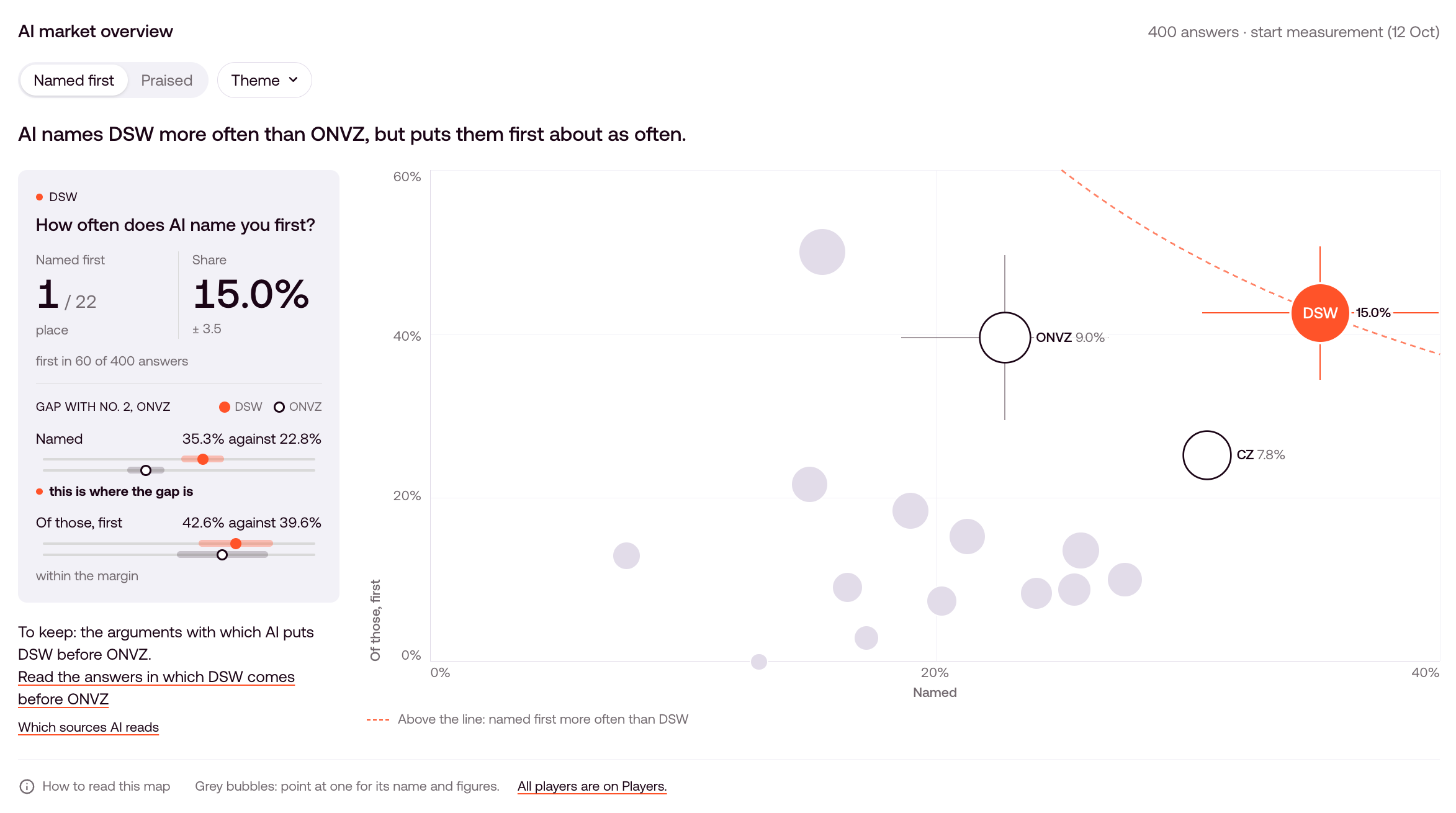
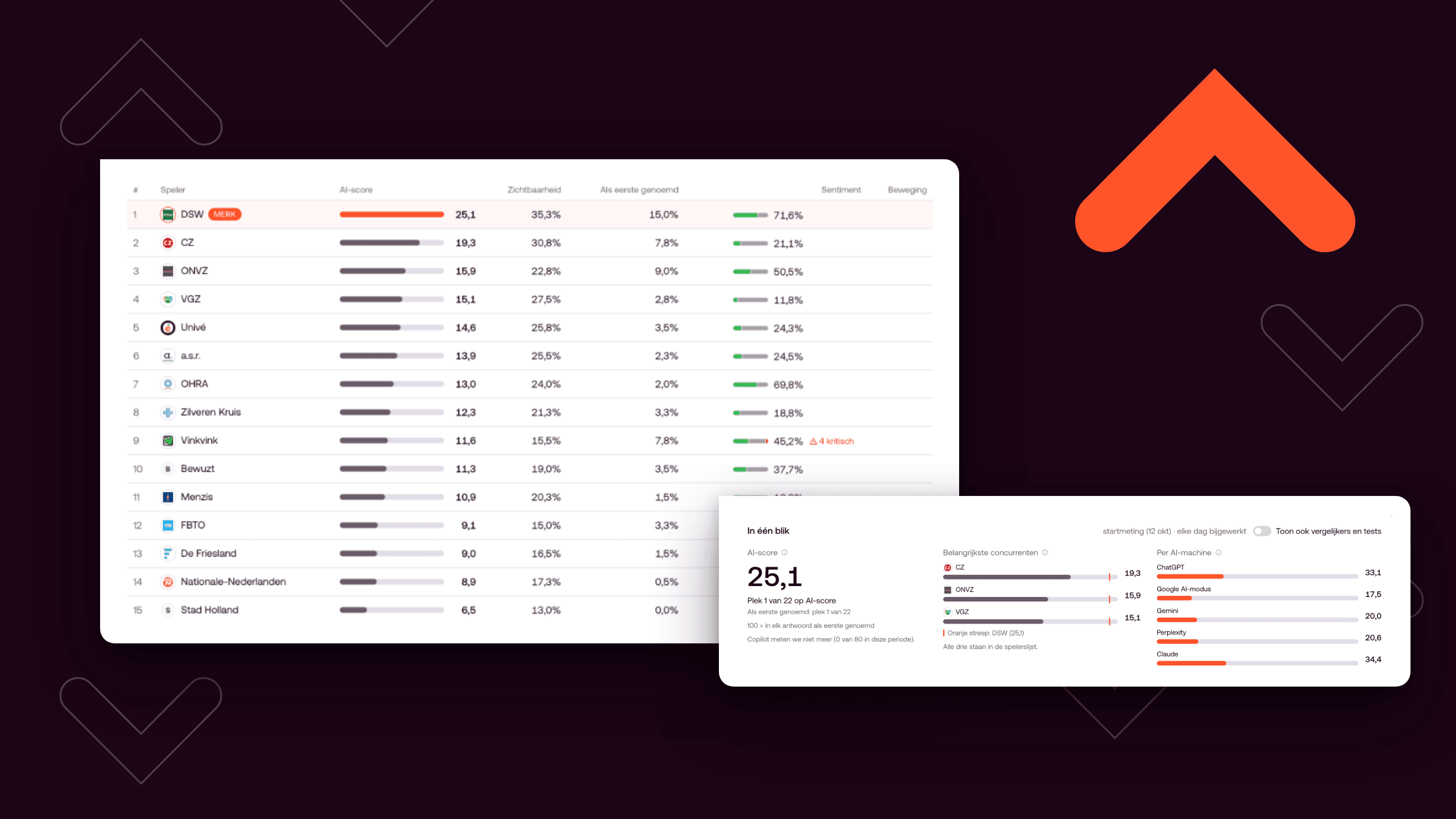
This is what the overview for your own brand looks like, here for DSW.
Already have a myWUA account? Log in to find the benchmark there.