Beating the competition is an achievement in itself. But some companies deliver such a strong and valuable website experience that virtually every other company can learn something from them. Which websites were those in 2022 and what makes them stand head and shoulders above the rest?
Research into the best digital experience
In 2022, WUA again conducted extensive CX benchmark research across seven different countries, including the Netherlands. In such research, we ask around 400 consumers from that country to orient themselves online toward purchasing a specific product or service, and then make a choice for their preferred provider. Throughout this entire process, we monitor their behavior, considerations, and choices. We then conduct thorough analyses of their complete search journey and final judgment. These benchmark studies generate comprehensive sets of both qualitative and quantitative data around customer experience. With this data, we're able to provide clear insights per industry into who the leaders are and why. Moreover, we can identify the overall Website Experience winner in the market per country, measured across all sectors and product categories. This Website Experience winner is the organization or company with the best digital customer experience in the entire country and is therefore an educational example for everyone. In the Netherlands, we have two companies that finished in a shared first place in WUA's benchmark research and therefore must share the podium. In this article, we explain which companies these are, why their online customer experience is superior to that of competitors, and what other companies could learn from them.

Winner 1: the crystal-clear booking system of NS International
Many consumers find it difficult to book an international train journey, especially if it's their first time. They have many questions and find it exciting. The chance of customers abandoning their shopping cart before checking out is therefore considerable. Because international travel products can be inherently complex, the online information flow during a booking process must be carefully designed.
Exactly the right amount of information
In WUA's benchmark research, NS International scores 76 points for clarity, compared to a market average of 64 points in the travel sector. The product we examined is a train journey from the Netherlands to Berlin. In the travel sector, it's traditionally difficult to achieve high customer experience scores – yet NS International has succeeded and scores remarkably high compared to other sectors. NS International breaks down all necessary information during the booking process into digestible chunks. Despite travelers having to enter lots of information and details and also receiving plenty of information back, the booking process remains clear.
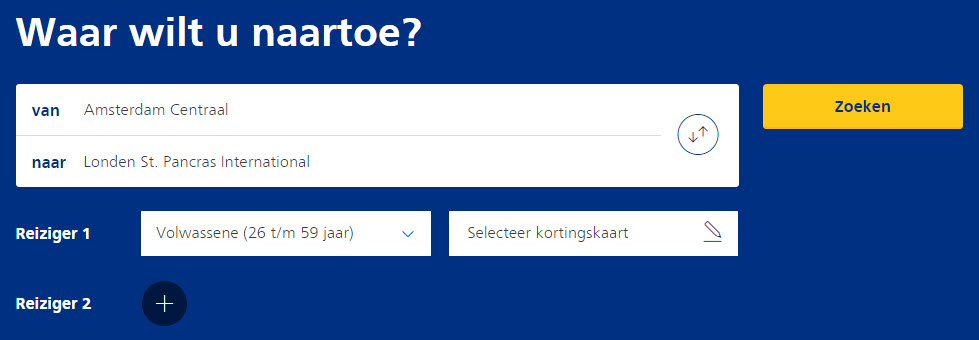
By continuously providing a clear overview in each screen of what's being arranged during that step, customers feel they have control and receive all necessary information. During the booking process, menu items are also removed from the screen once they're no longer needed. This prevents NS International customers from experiencing an overwhelming amount of information and makes the booking process feel streamlined. 
Decisive factors from the customer perspective
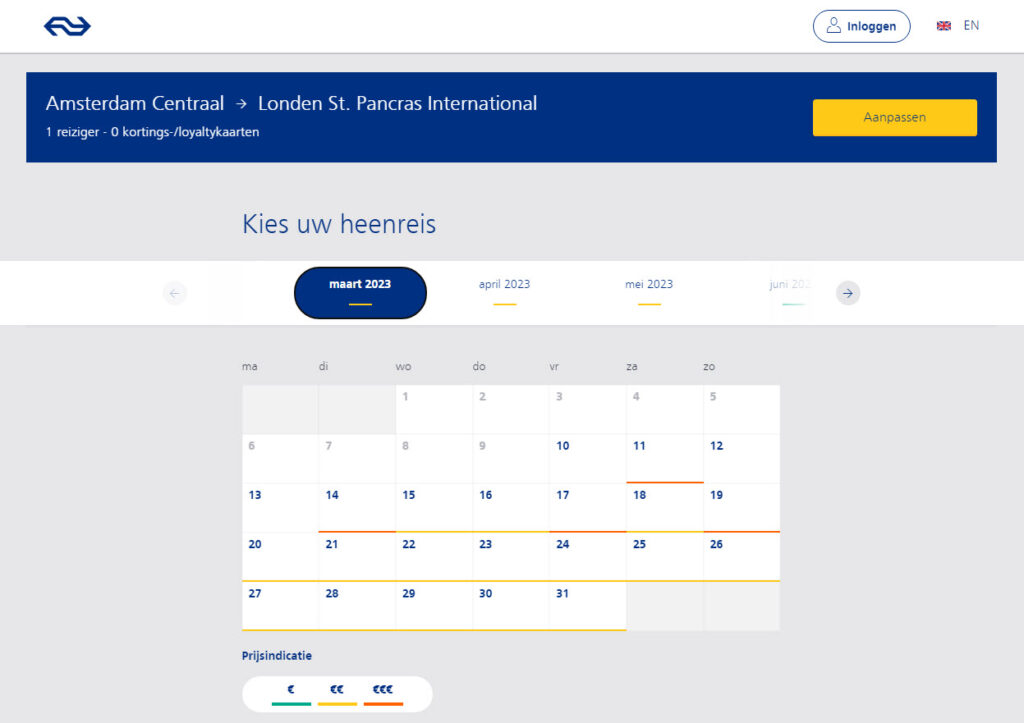
NS International offers the entire booking process from the customer's perspective. Price is a decisive factor in this. In almost all cases, the final price even determines whether a customer will book at all. Customers rate NS International at 61 points regarding price perception, compared to a market average of 54 points. When customers book a ticket on the website, they see an interactive calendar that uses red, orange, and green colors to show how expensive it typically is to book that specific ticket on that particular day. After a customer has selected a departure date, a more detailed overview of available times and corresponding prices is automatically displayed.
With this relatively simple functionality, NS International adds significant value to the customer journey. Customers appreciate being helped to find the most affordable ticket possible. It's immediately clear to customers whether they want to travel on a relatively expensive or cheap day.
Which learnings can other companies apply?
By giving extra attention to the most decisive factor for your customers, you can prevent abandoned shopping carts. For NS International, price is that factor. That's why it's been made as simple as possible to make a choice based on price in the booking process. An excellent overview during each step of that process further reduces the chance of abandoned shopping carts. With an intuitive customer experience, NS International helps its customers step by step toward a well-considered purchase. The most important learning that can be drawn from this: offer your customers the path of least resistance. Read also: Create the very best customer experience for mobile websites
Winner 2: Coolblue's choice helper
Coolblue has been scoring excellently in WUA's benchmark research for years. Customers consistently give the company high ratings when it comes to customer experience. We examined the customer journey when purchasing a new television: a customer journey that's well comparable between different retailers.
The shopping experience, but online
Electronics are expensive and complicated in many consumers' eyes. They encounter many technical terms they don't know and therefore can't properly assess what would be a suitable purchase. This leads to information overload, uncertainty during the orientation process, and high numbers of abandoned shopping carts. How can you, to prevent all this, offer the same level of personal help and valuable advice in a webshop as in a physical store?
Real help with choosing
Coolblue's online choice helper scores 78 points in WUA's benchmark research, compared to a market average of 70. This means consumers rate Coolblue significantly higher than its competitors. Consumers lose their uncertainty at Coolblue and, thanks to the choice helper, feel they're making a purchase that suits them. Of all parts of the digital experience at Coolblue, this choice helper is the component with the most persuasive power toward customers. It helps them cross the threshold to actually make a purchase.
Clear labels
A simple but very effective part of that choice helper is the use of the 'Coolblue's choice' label. This label is shown per product group on a small selection of products to directly guide customers without specific preferences toward a solid purchase they won't regret.
By clicking on the label, customers also see an explanation of why the label was placed on this particular product. This gives customers immediate valuable information about the product and provides them with several arguments for why this product would be a good purchase. Here, Coolblue successfully makes the step from abstract product specifications to concrete buying reasons.
Customer reviews are also part of the 'Coolblue's choice' label. A good average rating from other customers thus comes on top of the objective characteristics that make a certain product a good purchase. This significantly increases the chance of conversion.
Online selection assistant
Customers who prefer to choose from all possible products rather than blindly relying on a label can use Coolblue's selection assistant. Here, a customer indicates what they expect from their purchase and what they find important about it. What's distinctive here is that Coolblue speaks exclusively in the customer's language. For example, they ask what a television will mainly be used for (such as gaming, streaming, or watching sports) instead of requiring a customer to indicate which screen size, frequency, or other technical aspect they desire. The selection assistant links the right characteristics to what the customer indicates they want to do with their purchase. 
Which learnings can other companies apply?
The CX benchmark research clearly shows how successful Coolblue's approach is. The selection assistant lets customers enter information that a sales associate would also ask. This makes the orientation process and the journey toward a concrete product offering feel natural and familiar. Although this significantly increases the chance of an online purchase, there are always customers who prefer to see a product physically first before making the purchase. That's why Coolblue always highlights the option to come and view a television in one of the Coolblue stores. This way, Coolblue explicitly meets the wishes and preferences of a large group of customers. 
The best CX tactics from 2022 in practice
In our benchmark research, we focus per industry on one specific product and the corresponding customer journey. This way, we compare apples to apples and arrive at valuable insights. When we place CX insights from all kinds of different industries side by side, we're subsequently able to identify larger, market-wide trends. Companies that leave their competition behind this year and achieve the best customer experience operate precisely in traditionally difficult industries. This makes it extra valuable to learn from them. How have they, despite that challenging starting point, gotten so far ahead of their competitors? Seven points stand out. These companies:
-
Recognize and acknowledge what their customers struggle with;
-
Offer concrete tools to resolve those pain points;
-
Help customers by limiting the number of choice options;
-
Provide information in well-measured doses;
-
Make price indications immediately clear;
-
Clearly highlight good purchases;
-
Actively link product specifications to concrete customer needs.
Bridge online and offline and help customers choose
Coolblue has succeeded in making the gap between webshop and physical store as small as possible. Customers are helped online as they would be in a store and can thus make a well-considered choice. NS International makes it easy for its customers by displaying price information incredibly clearly and offering information in digestible doses. Both brands give customers sufficient confidence to make the decision themselves and proceed with a purchase. Customers aren't overwhelmed by information but rather feel supported and sufficiently informed to check out their shopping cart instead of abandoning it. These are elements that contribute to a superior customer experience and from which companies in all industries can learn something.