To stay ahead of the competition, you need to win more and more customers. To achieve this, your brand's digital customer experience (CX) must be continuously optimized, and all improvements must be implemented faster than the competition. A/B tests are a powerful tool for realizing data-driven optimizations, but they also have a high failure rate and it's difficult to know which elements should be tested as a priority.
In this article, we'll look at WUA's optimization approach and learn some key strategies to make your A/B tests more effective and successful from the start.
When your A/B tests are guided by the ideal approach below, you can achieve better results faster.
First: A/B testing - what is it for?
A/B testing is one of the most important weapons in your arsenal. It's a simple but powerful method. A/B tests ensure that every change you make to your digital experience has predictable, positive effects based on hard data. To get the most out of your A/B tests, it's important to understand the purpose and limitations of A/B testing.
The principle behind A/B testing is logical and scientific: you change one variable at a time, creating two variations that are compared to a "control." The control provides a baseline against which you can make meaningful comparisons between each variation. The numbers don't lie.
This methodical approach allows incremental improvements to be made to your website's branding, images, information, product/offering, navigation, layout, icons, style, or any other visible component. And with each change, you can measure the effect on the digital customer experience (CX) before implementing them permanently.
The limitations of A/B testing
In competition, speed is essential. And accuracy too. Despite A/B testing's built-in scientific methodology, it can be frustratingly slow and inaccurate due to its fundamental limitations. First, the failure rate of A/B tests is often high, especially at the beginning of optimization. In this scenario, many tests are run, but few of them point to CX improvements and can detract from the digital experience.
A success rate of 50%+ may be desirable, but many achieve only 10-30% success with A/B tests. Eliminating wasted tests is a priority.
With deeper customer insights, you can accelerate the results of smarter tests. You can also get a holistic view of the process that leads to conversion. Let's look at how you can achieve this.
Knowing what should be tested as a priority can be a huge boost for A/B tests and can accelerate results for any company, B2B or B2C. Common limitations of A/B tests:
-
One variable per test - You can only test one variable at a time with A/B tests while still producing meaningful results, limiting the number of tests per month that's possible.
-
No clear priority - Without knowing which elements should be tested first, it's difficult for web designers to apply A/B tests effectively.
-
Minimal dataset size - This is especially difficult for B2B companies, as the pool of potential customers is smaller.
The ideal approach: Evidence-based, thesis-driven A/B testing
Our approach is to guide faster optimizations by increasing the impact of each test and making each test more successful. This is the ideal, most powerful way to get successful results from A/B tests.
At WUA, we've seen companies achieve better results with evidence-based hypotheses that drive the process. When helping clients formulate their testing strategy, we find that thesis-driven A/B testing enormously accelerates the optimization process by increasing the impact and success of each test.
After all, a hypothesis is based on a "working model" of your conversion process and an understanding of what makes it successful. This insight is only possible with comprehensive, detailed data about the customer experience during the customer journey.
Without this insight, researchers are faced with a real "cart before the horse" problem: they need to urgently choose between multiple options without being able to distinguish which is most valuable.
How CX benchmarking helps build a 360-degree view of the customer
To make a solid hypothesis, you first need data. And not just any data - it must capture every part of the digital customer experience and help build a framework for how these parts work together. A 360-degree view is needed. So let's take a closer look at each customer's journey. First, an important fact: customers ultimately choose only one provider. This could be you, or your competition, but before they reach this decision, they must eliminate all other options along the way. In some cases, the driving factors behind their decision to exclude a potential provider can be surprising. It might come down to something as simple as the color palette or tone of voice. Or it might come down to a single important piece of information. With so many possible website elements involved in their entire experience, how do you know which ones will have the biggest effect? The answer is simple: we ask them. WUA uses a refined research method that allows unique insights to be obtained. These insights help you gain better understanding of their digital experience and which factors have the greatest impact on winning them as customers.
How WUA's unique CX benchmark methodology delivers rich Customer Experience Data
The methodology behind WUA's CX Benchmark data ensures we get a deeper view of the customer experience. In every benchmark study of a sector, service, or product, we survey hundreds of potential customers. It combines "hard" statistical data with "soft" data from qualitative responses.
WUA's benchmark data is also not limited by the imagination of researchers and data scientists - customers can freely indicate their priorities by providing them rather than just choosing from a "drop-down list" of options. This means you can identify critical issues that might have gone unnoticed.
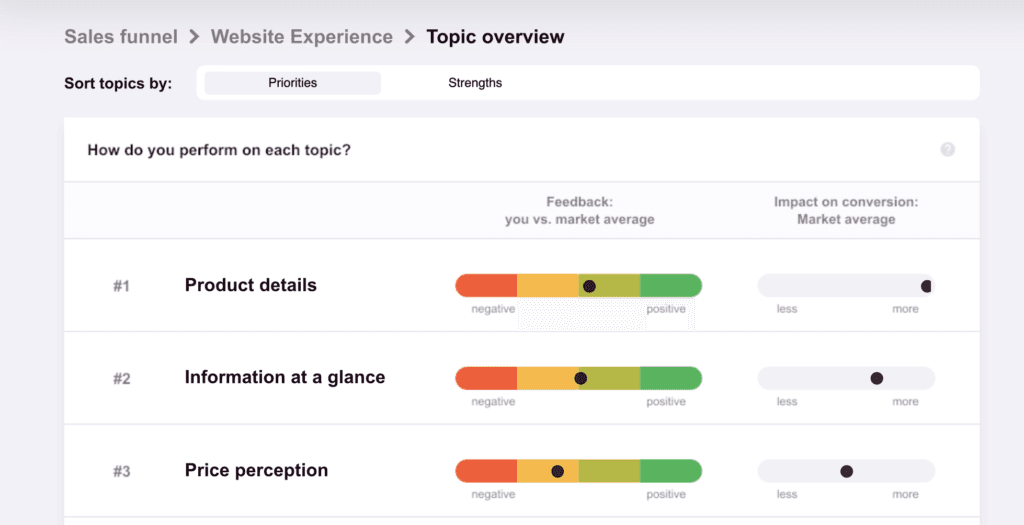
Each response is weighted by volume and total effect on conversion, so frequent "complaints" are only considered relevant if they actually influence the final decision.
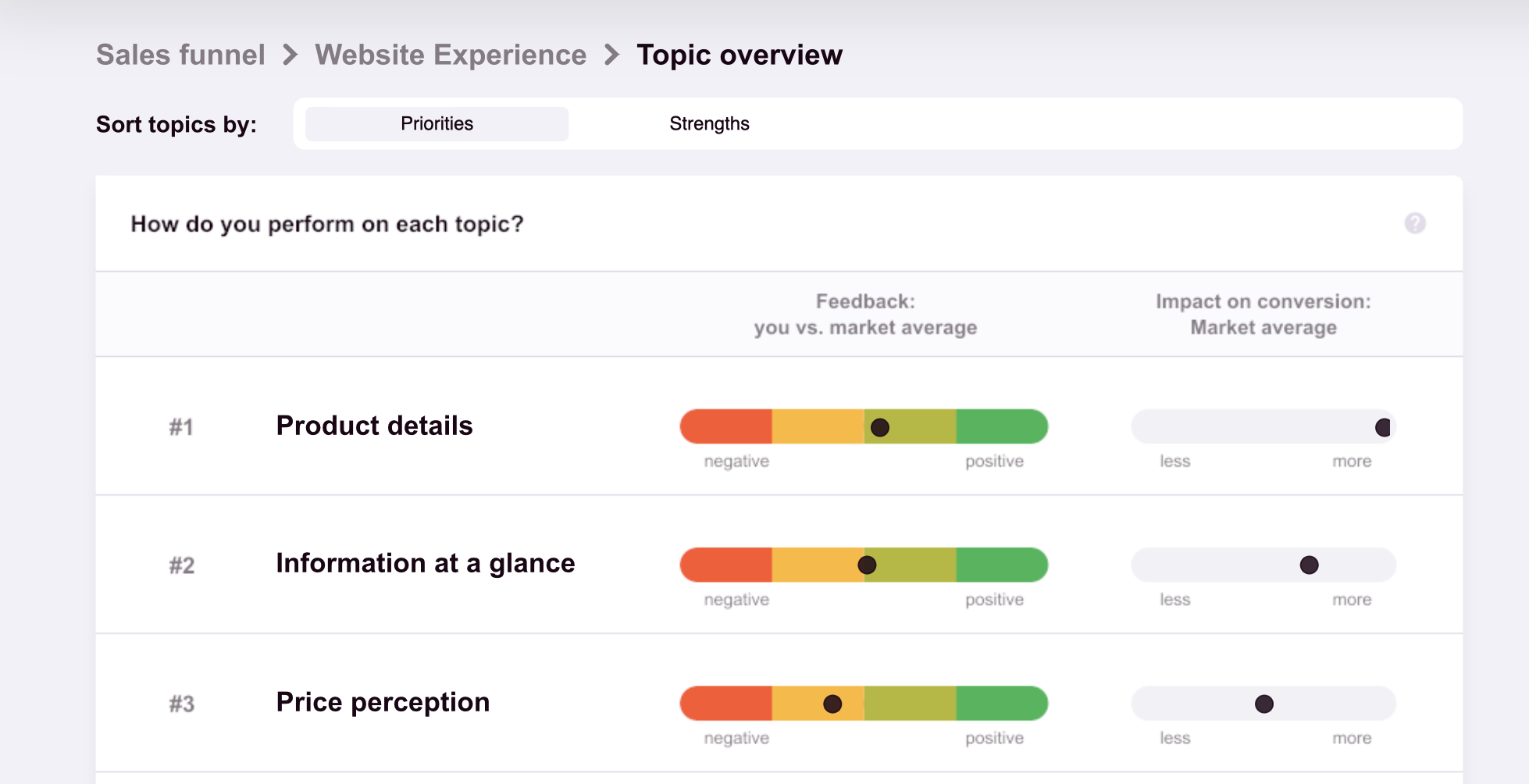
Example from the priorities module in the WUA Customer Experience Dashboard
So, for example, while 80% of visitors might hate your brand colors, this might not have as much influence on the end result as changing the layout or product information. The result of this methodology and the data it collects is a very special kind of knowledge of the entire experience. It can indicate which factors are most decisive for success. The synergy of using large datasets with both empirical and qualitative customer experience data means companies can focus their A/B tests on only those elements that have the greatest positive effect on conversion. With CX benchmarking, you know exactly where to focus your resources.
How you put CX benchmarking to work with A/B tests
WUA makes it easy for you to extract value from CX benchmarking studies with a user-friendly platform that gives you the depth of insight you need to improve your digital experience. There's a limit to the number of A/B tests you can do, so our data helps optimize this by prioritizing testing only the most relevant elements. This way, you get the most value from each test. When it comes to actually applying this data to A/B tests, our researchers can advise on strategy. This can accelerate results from the start. We don't even need to see the A/B test results themselves, because the strategy is already directly determined by the customer experience. This means we can provide strategic advice that is unbiased and based exclusively on solid and reliable data.
With WUA's strategic guidance, your A/B tests can focus on the most urgent priorities. The results show in improved benchmark performance and improved conversion.
By testing only where it counts, your optimization can happen faster and more accurately, allowing you to maintain your market position and your lead over the competition.