
Customer experience can make or break a business. For today's consumer, it's everything when it comes to loyalty and making purchases. That consumer expects a superior digital customer journey, regardless of which device they use or what exactly the goal of their customer journey is. That's why it's important to constantly map the customer experience within your organization and compare it with that of your competitors through CX benchmarks. But what exactly is CX benchmarking? A smooth, high-quality CX is one of the most important weapons in the battle for the online consumer. Companies with a distinctive CX grew more than twice as fast in revenue between 2016 and 2021 compared to competitors that fell behind, according to research results from McKinsey. Customers of such CX leaders are also willing to spend more money with them and are less likely to switch to a competitor. A superior CX creates loyal customers and at the same time serves as a means to steal customers from competitors. However, CX encompasses much more than just offering a well-functioning webshop or a bug-free app. But what exactly? And isn't CX the same as UX?
CX is more than UX
There is still regular confusion about what CX actually involves, often leading to confusion with user experience (UX). When we talk about UX, we're referring to the experience a consumer has at the moment they use a specific platform, system or app. What precedes that part of the customer journey or what comes after it remains out of consideration. 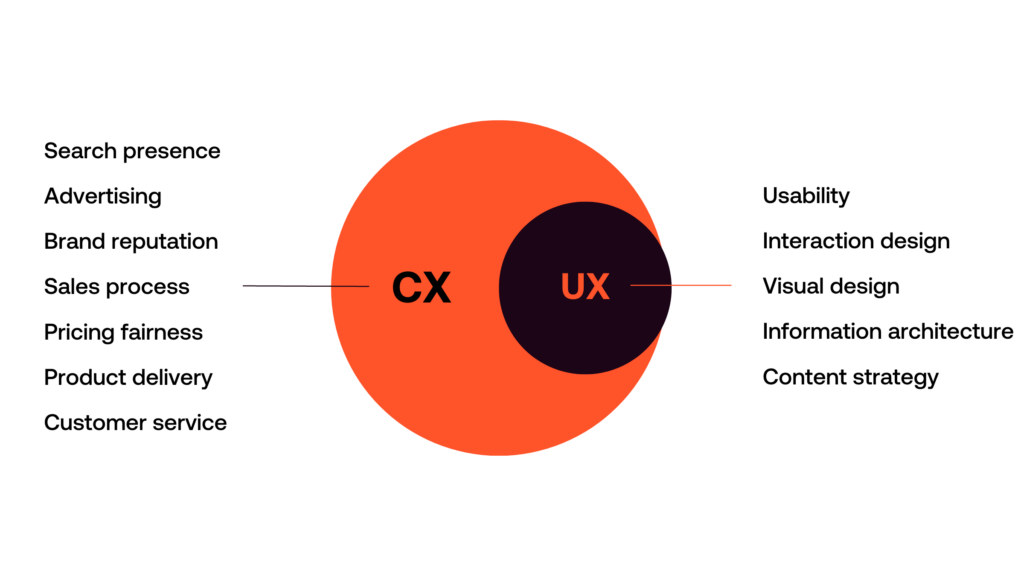 UX can therefore be seen as part of CX, which concerns the total experience a customer has with your organization via all available omnichannel touchpoints, both digital and physical. So it's not just about your company website and what consumers can do there, but about the interplay of that website with your app, social media, physical stores and all other channels and touchpoints.
What does the digital customer journey look like, from sales to service?
This section first appeared as a separate article in 2017.
The Digital Sales Journey
The customer journey often starts online. In this orientation phase, the consumer goes online to find information to become more familiar with the product, for example. Here, they encounter various parties who provide what they are looking for and develop a preference for a particular provider. The tremendous yearly growth of online spending shows that Dutch consumers often complete their purchases online. Over the years consumers are spending more and more on online shopping and purchasing services such as travel and event tickets. (source: gfk.com, Thuiswinkel Markt Monitor research)
Especially in online, an optimally organized customer journey on the website is key. After all, for the consumer, a different ‘store’ is just one click away. If you want to keep a consumer happy on your website and convert them, you have to at least offer them a clear journey without obstacles that slow them down (e.g. unclear visual navigation, too much information, irrelevant information, an unreliable impression, or technical issues). Companies often get it wrong still, which is evident from the fact that many have low conversion rates hovering around 1%. Unbelievable, really: there are 100 consumers in your store, and 99 of them leave without buying anything.
Consumer’s digital journey often doesn’t start and end with a visit to a single store
To get the journey in order, usability tests, A/B testing, and pop-up questionnaires on the website offer a solution. But what is often overlooked, is that a consumer’s digital journey often doesn’t start and end with a visit to a single store. Natural behavior would be visiting multiple websites by Googling keywords, entering company names directly into the address bar in the browser, or visiting comparison sites.
The advantage of usability tests is you can get inside the mind of the consumer: what do they experience when entering your website and what do they think? Researching the online customer journey, on the other hand, gives you insights into what is happening within the competitive environment. What do people experience on different websites with respect to one another? What makes consumers prefer one but not the other? Which aspects of the customer journey take priority when it comes to improving?
The Digital Service Journey
These days, the optimal organization of online self-service is considered to be almost as important as the digital sales journey. By allowing consumers to answer their questions themselves online, make changes, or manage an account, there is a ‘win’ on both sides. Companies can reduce their service center costs and thus achieve higher margins, and consumers can get to work whenever it suits them. Without having to worry about office hours, waiting times, and menus. Our own WUA studies show that more than 70% of consumers want to be able to deal with service-related issues online. And this percentage is increasing rapidly. In order to optimally organize self-service online (think apps and the My-environment within websites), it is fascinating to find out what is the standard in the world around the consumer. This standard is determined by the best in class – that is the bar the consumer will set for you.
Control over your CX through benchmarks
A fully optimized CX brings a fundamental competitive advantage and ensures that customers want to spend more with you than with someone else. At the same time, a poor CX can cause even the best offering in the market to result in declining market share and thus contraction. Having control over the CX you offer your customers is therefore very valuable. You need to know where you stand, what you're good at and where improvement opportunities lie, to be able to do better than your competitors when it comes to CX. That's why benchmarking is so valuable. With periodic benchmarks, you get a crystal-clear picture of the quality of your CX and its ongoing development. CX benchmarking works in two ways: internal and external.
Internal CX benchmarks
With internal benchmarking, you look at the performance and results of your CX compared to your own past performance and self-imposed targets. You measure whether your CX improves over time or unfortunately deteriorates. This gives you insight into whether changes you implement in your digital customer journeys have the desired effect and whether you achieve your goals with them. Internal CX is valuable, but doesn't tell the whole story. You have an idea of how you perform, but not whether you're doing better than your competitors. So you don't know whether you can win customers from your competitors in the long term, or whether you can expect an exodus of your customers to other parties. External benchmarking is needed for that.
External CX benchmarks
With external benchmarking, you compare your own CX performance with that of your main competitors in your industry. Becoming a CX leader in your market segment means not only that you must continuously improve your CX, but also that you must do so more successfully than your competitors. Your internal benchmarks may show that you're continuously improving, but meanwhile you could still be losing market share. That's because your competitors are improving faster than you are. Also read: Creating the very best website in your market? Think outside-out Consumers today have an increasingly large abundance of choices. Therefore, the importance of external benchmarking is growing. Switching to a competitor is relatively easy now that customer journeys in most industries have been partially or fully digitized. Being overtaken by a competitor that innovates their CX much more effectively can therefore have lightning-fast consequences in the form of declining market share. That's why you don't perform external benchmarks just once, but they form part of an ongoing process. We made an explanatory video about what Customer Experience Benchmarking is:
What method does WUA use to benchmark the customer journey?
This section first appeared as a separate article in 2019.
From a vague idea on how to improve your website to using benchmark data to offer the best CX
A lot is said and written about customer journeys, there is confusion about the concept, there are people who are in favor of customer journey thinking, others are against it. At WUA we have been using a rather practical approach for more than 10 years: we give potential clients an orientation task concerning the purchase of a product or service, and we identify what they experience on their customer journey from start to finish (until just before the ‘buy’ or ‘exit’ button is used). This is done using a long questionnaire based on the Digital Sales Model.
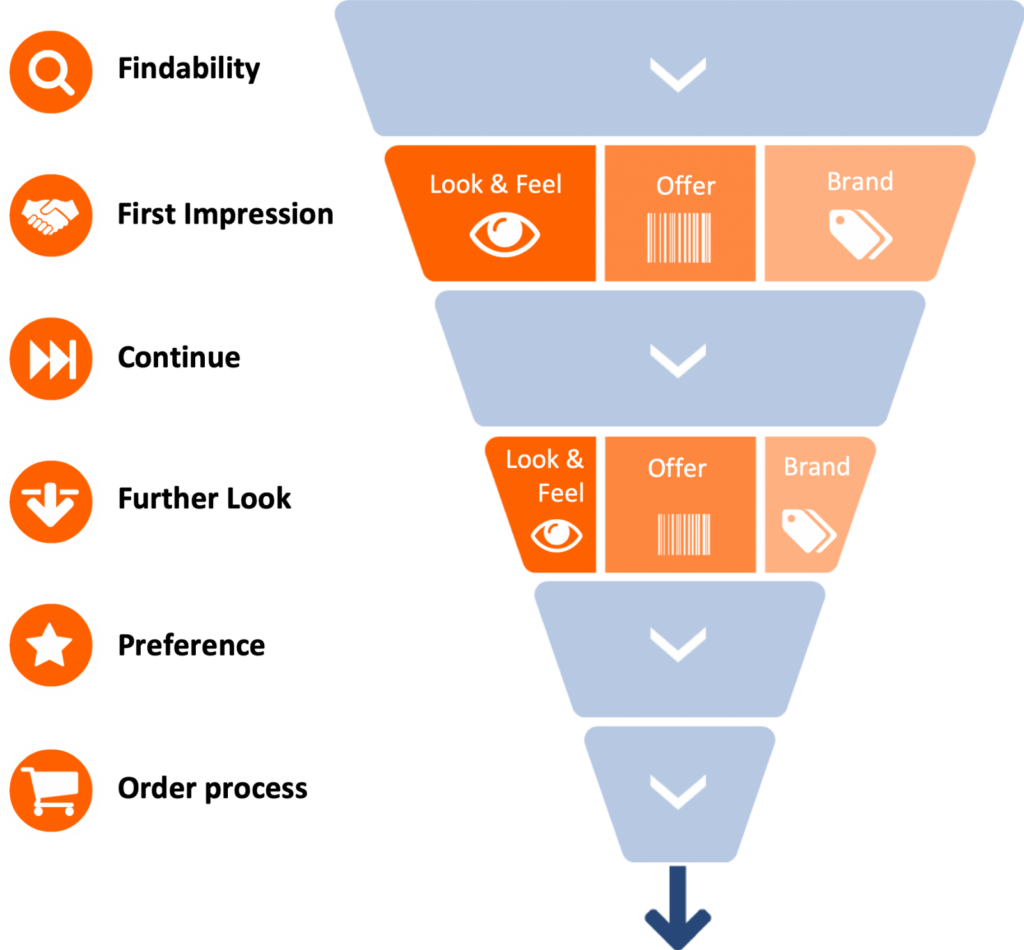
Every marketer recognizes the funnel in this model, and that is why the model is structured in such a way. First, as a company or provider of a service, you are either found or not found at the beginning of the customer journey. Then a first impression informed in the aptly-named first impression phase, represented by a ‘score’ on the themes of look & feel, offerings, and brand.
Based on this first impression an important decision is made by the potential customer: do I continue on the website of the service provider I’m currently looking at, or do I give up and look for someone else? If you give up, the customer journey and assessment of the experience of that customer journey starts again. If you continue, you get to the deepening phase.
In this phase too, potential customers assess what they see using the same themes as in the first impression phase. Then they produce their overall opinion and eventually follow their preference and choice of provider. And it is mainly about why that choice was made. Why indeed CZ and not Menzis as their number 1? Or if you’re opening a bank account: Why is Rabobank so much better than ING? Why choose E.ON over Nuon for an energy contract? What is E.ON doing right and what does Nuon need to improve on to be chosen as the number 1?
CX benchmarking as a mirror for your organization
To remain profitable and healthy in the long term, you must stay ahead of your competitors in terms of CX. Continuously conducting both internal and external CX benchmarks is fundamental to this. Without measuring, you can't improve. These benchmarks provide your organization with three concrete advantages:
-
Complete vision of your digital customer journeys. Including insight into possible UX and CX improvements that you can't extract from traditional website measurements.
-
Reduce customer churn. Customers come on foot but leave on horseback. Benchmarking makes it clear what drives departing customers to switch to a competitor. You can then respond to this.
-
Confident decision-making. You have all the necessary data to know for certain that investments actually deliver something.
What other benefits does CX benchmarking bring?
This section first appeared as a separate article in 2024.
Consumers benchmark too
In all our CX research, we look at real customers making real purchases from real companies. This shows that consumers, albeit unconsciously, also benchmark. They try the app, website or platform of different providers and ultimately choose the party that offers the best experience. Your customer's journey therefore also takes place largely at your competitors' touchpoints. If you don't pay attention to this, you don't know what your target customers experience there. You're missing a lot of valuable information that you could have used to your advantage. If you conduct structural CX benchmarks, you always know exactly how your competitors are performing and what your customers experience with them.
Brand loyalty becomes convenience loyalty
89% of consumers nowadays consider switching if they have a poor service experience with their provider. Customers are therefore becoming less and less loyal to brands. They no longer stay with the same insurer, bank or energy supplier their entire life. Instead, they're loyal to convenience: the company that can offer them the smoothest and easiest customer journey wins their business. CX benchmarks show you during which steps of the customer journey your customers experience inconvenience compared to your competitors. These are important elements to implement improvements on. Without CX benchmarking, you'll never get this insight.
Continuous new data and input for A/B testing
Continuous benchmarking provides continuous input you can work with. Structural benchmarking is therefore an excellent instrument to feed A/B tests. You start an improvement engine that runs continuously. Many organizations do conduct A/B tests, but their content consists of gut feeling. They test for the sake of testing. This happens because there's no structured, objective data stream that can be used as input. CX benchmarks form such a data stream. A/B tests become much more valuable this way.
The right focus for every department
A good CX doesn't only depend on a pleasantly functioning website or app. After all, the modern customer journey takes place omnichannel, where online and offline intersect and sales and service go hand in hand. CX therefore also includes, for example, a sales team that can answer customer questions well and quickly, a product that delivers on customer promises, and a marketing team that continuously knows how to strike the right chord. CX benchmarking helps bring focus to all departments that have impact on the customer experience at your organization. It provides concrete tools that a sales team, marketing team or product team can work with. For every department, it's crystal clear what needs to be done to contribute to CX objectives. An organization starts working better together and departments strengthen each other from their own role.
Good CX benchmarking delivers the ultimate market information and holds up a mirror to your organization. It makes improvement opportunities visible and objectively shows how the company performs compared to the competition. That's knowledge no successful company can do without.