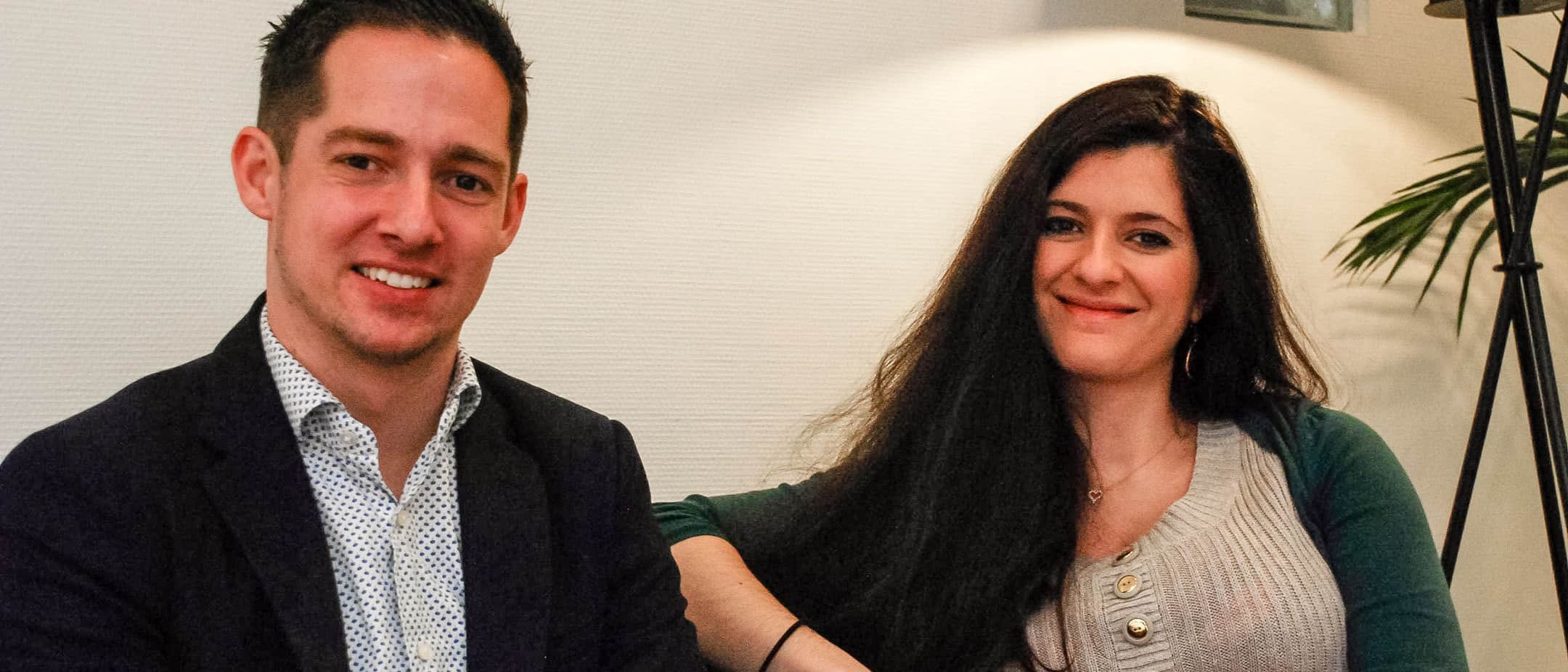
Monuta is seen by potential customers as the best in the WUA research on online orientation for taking out a funeral insurance policy. Monuta also scored very well in the WUA service research among the 4 major funeral insurers. In this interview, we speak with Robert Hollander, Business Manager Direct Distribution, and Sahar Salimian, Customer Manager responsible for service. About continuous optimization, helping customers completely in 1 conversation, call reduction, and service challenges.
Robert Hollander and Sahar Salimian, congratulations on winning these two WUA studies. How important do you find it to be the best in the digital arena, in both sales and service areas? What role does having a winning mentality play in this?
Robert Hollander (RH): "We definitely find winning important. One of our objectives is that we want to become and remain market leader in the industry. So it's important to be the best, particularly in what customers think about that. That we find this important is certainly true."
Sahar Salimian (SaS): "On one hand, it's about continuously improving relative to ourselves, on the other hand we also certainly look at what steps our industry colleagues in the market are taking and how we can stay one step ahead of them. The focus is particularly on being relevant and personal, providing tailored information to customers, and on transparency.
"Happy people make happy customers. That's absolutely what we stand for. We strive to have made customers aware by the time they hang up the phone or when there has been email contact. Are you over-insured? Then we can do something about that. Are you under-insured? Then we can also do something about that. And have you ever thought about your wishes regarding the funeral? With these questions we utilize the contact moment. We also try to be proactively in contact with customers who don't seek us out themselves, because ask yourself: when did you last call your funeral insurer, should you have one?"
RH: "In our department there is naturally a sales target: it's simply important for us to be the best. We have a team with a winner's mentality: good is not good enough. We have young, ambitious people. They are eager, work together toward a goal and really go for it. I see that it works. Despite things going well, we absolutely don't sit still and try to continuously challenge and improve ourselves."
What is your approach, what goes so well? What can other digital leaders learn from your approach?
RH: "We want to be in control ourselves. In our strategic annual plan it even states that we want little dependence on agencies, want to learn a lot ourselves and bring and keep the digital knowledge in-house. If we now work with an agency, then I find it nicest if they come to our office. We focus on knowledge sharing. Not necessarily with the goal that we will ultimately do everything ourselves, but to make our own marketers even smarter."
SaS: "I think it's in a combination of on one hand a healthy mix of new, young and innovative professionals, and on the other hand expert people who have simply been with us for a very long time and know the subject matter through and through. It's a golden mix that we have with the mentality that Monuta pursues: not the costs or revenue, but the customer is leading.
"I absolutely think that's a big difference from my previous employers. Everything we did there had to quickly deliver something, while at Monuta we believe more in long-term customer loyalty. If you have sufficient savings and can arrange your funeral well yourself, then we find that okay too. We are transparent about that. This is how we surprise customers: the average customer is still used to a company wanting to immediately profit from him or her."
From a consumer perspective, there should be no difference (anymore) between service and sales. Are you well able to break through the silos at Monuta or: are you planning to do that?
RH: "We see that very practically. The sales and service departments at Monuta literally sit next to each other. So we walk by each other a lot. There has even been exchange between people from my team and the service team. That says enough too. We see that sales and service are coming closer and closer together. In our mission ('For everyone a farewell with a good feeling'), there is both a sales and a service component."
SaS: "One flows into the other. We don't separate it. We have a very broad customer portfolio, so some customers became customers 60 years ago. Then we offered completely different products than we offer today and the costs of an average funeral were very different than now. So our service challenge lies in making the customer aware.
"Customers certainly aren't waiting to hear something from Monuta every day about his or her funeral and insurance. But when the day arrives and the time comes, the customer does expect from us that it is well arranged. We see that as our biggest challenge. It is a sport for us to inform the customer about his or her personal situation and make them consciously think. And with that I think you combine sales and service."
RH: "What makes our work distinctive is that we handle both the insurance piece and the funeral piece. We see that people want to arrange the financial piece well, but when taking it out don't want to be too busy yet with filling in a funeral. That's maybe logical somewhere, but also unfortunate: your wishes do have an influence on the costs of your funeral and thus on the amount to be insured. So we have the assignment to also get the filling in clear in the 50 to 70 years that sometimes sits between taking out the policy and the actual funeral."
SaS: "And all that with a good feeling. At the end of the road there shouldn't be much money left over in a policy that isn't used. That's not in our advantage. Survivors don't have a good feeling about that. So that's really a mission: our customers must not be over-insured but also not under-insured at the moment of farewell. That's a big challenge in the area of service and sales."
What role do customer research and putting the customer central play in your daily work and with the teams that fall under your responsibility?
SaS: "We speak with the customer day in, day out. The voice of the customer is thus well present within the walls of Monuta. In addition, we measure customer satisfaction integrally on all our touchpoints. NPS is an important KPI in that. Fascinating and distinctive in our line of work is that some customers 'disappear from view' because they for example no longer pay premiums and no longer get direct debits because their premium-free age has been reached. Your insurance naturally remains active, but we speak less with this customer group. If you talk about putting the customer central, then this is thus a focus area where we focus on. How aware is this group of which products they have with us? How can we provide them with more service?"
RH: "With us it's naturally a bit different. To continuously improve ourselves digitally and become smarter, we do a lot of customer research, usability research and benchmark research. I find it very important that our website is understandable for customers. I want people to choose consciously and that when someone takes out an insurance with us, he or she also really knows what the choice entails. That's I think the most important part of our customer research: user-friendliness in combination with comprehensibility.
"Taking out a funeral insurance is often an impulse purchase. If you have just closely experienced a death, for example. You can take out an insurance with us within a few minutes with a few clicks. Fine, but it's tremendously important for us that people stay and don't cancel their insurance after a year. In the first year that chance is greatest. So we must ensure a warm bath, decent communication about the policy and arrange payments well for our customers. That ensures that we get and keep happy customers."
SaS: "If we have dropout, then we want to know why and we investigate that. We call customers for example and ask about their experience. Ultimately we also want to be busy with that based on predictive models, for example with data from payment behavior. We can still grow enormously in that."
Which KPIs do you use in the digital area, which knobs do you mainly turn to excel digitally?
SaS: "Our strategy is: customer chooses channel. We don't push toward digital because it's a 'cheaper' channel. The customer chooses his own channel, whereby it is the case that the 'traditional channels' are meanwhile well arranged and that we still have to develop much on the 'new channels', especially digital. We are fully investing in our online channels, particularly our MyMonuta channel, to realize 100% self-service: the customer who wants that can arrange everything online themselves. We have already made beautiful steps, but we're not there yet. And KPIs around that are also still fully in development."
RH: "Naturally we look at efficiency, but ultimately it's about the customer being helped in one conversation. Maybe that's also a nice one: a KPI that you can develop for the number of conversations needed to really help a customer. With for example first time fix as starting point."
SaS: "Yes, first time fix! That the customer thus doesn't have to call back but is helped in one go. Those are things we currently steer on with the traditional channels: one Monuta employee should be able to help a customer with everything. You don't have to transfer to another department anymore. Sometimes, unfortunately, we still have to put the customer on hold to check something somewhere and then come back to the customer. We immediately see that back in a lower NPS.
"Speaking of KPIs: we don't focus on call duration. It's not relevant. That's a big difference with traditional call centers, because they almost all do that. There you see that many customers have to call back, because the first conversation thus had to be finished within so many seconds. Call reduction is not a goal in itself for Monuta. Except naturally the calls for which the customer didn't want to call. We naturally want to reduce those as much as possible."
RH: "For my team conversion remains the most important KPI. We sit in an extremely competitive industry with high costs. To keep those costs under control, good conversion figures are important. Customer research plays an important role in that. How can we ensure that customers on our website can better find their way and thus also take out more insurances?"
What are your digital challenges for 2017?
RH: "I want to continuously improve, particularly on the data side. We have tremendous possibilities with data. We have good systems, we dare, we have short lines. So we can also try a lot of things. Bringing together different data sources to service the customer even better and become even smarter in that, that's the challenge for this year."
SaS: "I have two big challenges for this year. The first is taking further steps in that everyone can help every customer completely and the second is making 100% self-service possible for the customer who wants that. It's about empowerment in the systems and in knowledge, in the right place."
What digital innovations are you currently working on and what developments are on the roadmap?
RH: "We want to personalize even more with data and test different versions of our funnel. We have long focused on conversion and improving the funnels. Coming year we want to focus more on storytelling. Telling Monuta's story and working more with content. We want to warm consumers earlier in their customer journey for Monuta. More personal, maybe also tell more about the funeral theme..."
SaS: "We want to give the customer the possibility on the service side to make online adjustments to his insurance. You still have to call for that now. We are also working hard on the connection between insurance and funeral in the online channel. If you for example log into MyMonuta, then you now see the funeral center near you. That's the beginning of digitally organizing the end-to-end customer journey.
"But: we find that the customer should be able to take out an insurance and also be completely free to determine in the future where he then wants to do his funeral. You can want to lock in a customer beforehand, but we challenge ourselves to let go of that locking in. The customer must choose himself in the future. If we are then the best, the customer naturally comes to us."
What is in your opinion The Next Big Thing in digital in your market?
RH: "Difficult to answer. The insurance world is enormously in motion, with fintech, with all kinds of new developments. We want to move along and lead ourselves as the new insurer of the future. That we won't be organized in 30 years like we are now, we know that for sure..."
SaS: "I think the insurance world will look completely different in 10 years than now, but how exactly? In the fintech world you see startups emerging that change the market in a groundbreaking way. Compared to that development we are now still quite a traditional insurer that does the whole process from A to Z ourselves. We see companies emerging that take one small piece from that process and make that fantastic, digital, easy, simple and cheap for the customer. What does that then mean for us? I don't know exactly yet."
What is your ultimate goal and dream to achieve in business?
RH: "For me the dream begins with pleasure. Working together with motivated colleagues, who really have heart for the cause and who want to work together to do new things for the customer. Who dare to fall on their face, experiment and learn. We have very short lines so we can switch quickly. We are big enough to do beautiful things. We have a beautiful brand, we have good budgets and good opportunities!"
SaS: "I want us to become the identity in the field of funerals in the Netherlands, the only real number 1. The customer chooses us himself for his insurance, and 100 years later also again, or still, for Monuta when the time is there to say farewell."

