
We conducted conversations with our most valued clients to discuss the role of the WUA Digital Experience Dashboard in their organization. In this edition: Sjoerd Roders, marketer at DELA.
What does your work at DELA look like? Can you tell us more about your role and the organization you work in?
"DELA was founded more than 80 years ago to ensure a personal and dignified farewell for its members by insuring and organizing funerals. At DELA we currently have four marketing teams working on expanding our propositions and keeping them up-to-date to meet the wishes of our (future) members.
"I work as a marketer in a team focused on growing our customer base. That means offering our insurance policies through various channels, especially online. Our other teams focus on the brand or work more on offering our funeral products and services. We also have a team focused on improving service to existing customers."
What challenges do you and the teams at DELA face to accelerate digital growth, and how do you address them?
"The challenge is that we, like every insurer, have a lot of work to do in the IT landscape. We've been around for more than 80 years and the world has changed and become more digital than ever. We work hard to keep up with digitalization and the rapidly changing digital landscape. We're committed to keeping our digital products up-to-date and also using new technology to innovate. There's a lot of work to do, so you have to make choices and set priorities: What do I do now and what do I do later?
"Implementing improvements based on market research or the WUA Dashboard sometimes has to be put on hold when other major projects come up in the meantime. We often find that we have to make a case for how important these improvements are so we get the IT resources we need. The proof is in the A/B tests. That gives us many strong arguments to implement the optimizations. And it works great: The increase in volume for insurance applications enables us to prove the value of the business case for implementation. Besides those indicators, we also look at customer effort score and customer satisfaction score to assess the A/B test results and show how it adds value for our customers."
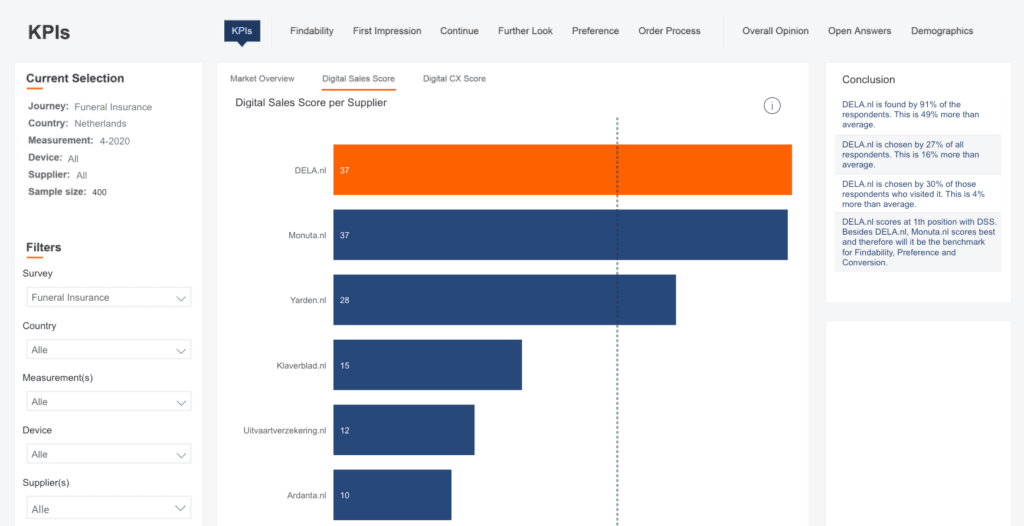
At DELA you've been working with the Digital Experience Dashboard for a while. Can you explain your approach?
"In the past we bought the Web Performance Scan reports from WUA. We always work with a combination of reports, management summary and workshops. That has always worked out very well for us. The reports really give you clear recommendations.
"Now the Digital Experience Dashboard gave us a new approach, and we were very curious how that would work out. The session with your research consultant, Martijn, where we went through everything, really helped me a lot. We performed some tasks and learned how we could use the Dashboard ourselves.
"The Digital Experience Dashboard gave us a new approach, and we were very curious how that would work out."
"After the onboarding session I did a deep dive myself and started not only looking at the main scores, but also zooming in to see the details. What I really liked was that I could just write down a list of the most important topics in my notebook. And I kept checking the open answers: How do they relate to our own scores, but also to our competitors' scores? I tried to extract information from every aspect of the scores: What are the key points that stand out? And what exactly are the questions and topics where we didn't score as well as our competitors? For some components I could find detailed answers to these questions.
"For example, we got a lot of feedback from people saying they didn't like our typography very much. And that's obviously important to know, because the last thing you want is for typography to put customers off. I consider fonts a fundamental element of your website. It shouldn't be a distraction for the customer. We got many comments about it, and our competitors hardly any. So that's definitely something we're changing. We're doing research to find out which fonts are better suited for our users."
You used Sticktail to bring the results and the backlog with insights and follow-up actions into the DELA organization. What was your approach?
"I had made a lot of notes on paper in my notebook, and I was looking for a way to share them with the rest of the organization. Sticktail is a platform that helps you write down your insights. You have observations; the differences in scores for example. And you have facts. You use the facts to formulate your insights. They have a template for that, and that's how I started putting my insights into words. This platform works well for the rest of the team: People can click through, read the notes and make comments. The notes have become like little articles, and the reading time in minutes is also always shown on the screen."
Which specific topic or feature of the Dashboard has the most value? What do you find most useful or interesting?
"I find the six different tabs in the Dashboard the most useful feature. You can click on everything that belongs to the topics. And that's really handy in combination with the open answers, which you can select by facet or topic. It's good to do it in this order: first the score, then we look at the questions where we didn't do so well, and then at those where we did better than competitors. That has helped us tremendously with analysis and finding paths to approaches."
"We extracted an enormous amount of information from this research."
"And another thing: For me, an important difference between the custom Deepdive report and the data-only Dashboard is the usability of best practices from other companies and other industries. I notice that when you work with the data-only Dashboard without best practices, you focus more on your own website. I think there's a lot of valuable knowledge we can gain from WUA's expertise in this area!"
What results and improvements are you most proud of, through using the Digital Experience Dashboard?
"We extracted an enormous amount of information from the research, and it's all extremely tangible and usable for addressing the funnels. That's on the agenda for next year.
"Something else I want to say is that we're focusing on figuring out what the overarching orientation process looks like, and how customers form an opinion, even offline. We're trying to map this using diary research. We want to follow people who are trying to find their way through funeral insurance. We want to get qualitative insights. So we're going to take a step back to get a broader picture. Together with the Dashboard, that gives us a complete picture of what and where we need to improve to optimize our customer journey!"

